

Georgia’s Republican races for governor and US Senate head to June runoffs
Keisha Lance Bottoms wins Democratic primary outright, while Republicans Burt Jones and Rick Jackson will face off
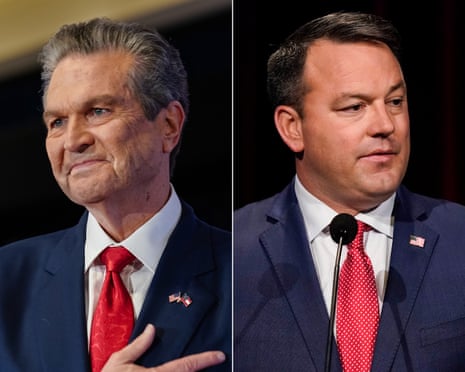
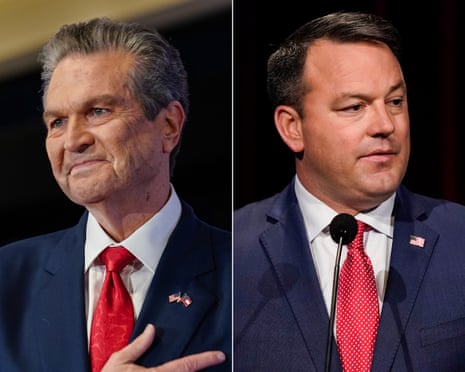
The Republican primary campaign for Georgia governor will go to a June runoff, with the lieutenant governor Burt Jones facing off against healthcare billionaire Rick Jackson – and locking out Brad Raffensperger, the Georgia secretary of state and longtime political enemy of Donald Trump who was on track to finish a distant third.
The Republican race to challenge the US senator Jon Ossoff remains similarly unresolved, while former Atlanta mayor Keisha Lance Bottoms won the Democratic primary for governor outright.
Meanwhile, two Georgia supreme court justices won re-election, fending off Democratic-backed challengers former state senator Jen Jordan and personal injury attorney Miracle Rankin.
Judicial elections in Georgia are nonpartisan and decided on primary election ballots. The Georgia supreme court has no Democrat serving on it, because primary elections typically have had lopsided Republican turnout. The court is currently considering the constitutionality of a six-week “heartbeat” abortion ban, which added subtext to the race. The race has been heavily advertised and promoted online in ways that have historically been unusual for a judicial race in Georgia.
The judicial contest has at times overshadowed the race to replace the outgoing Republican governor, Brian Kemp. Polling over the last month suggested that a runoff in the well-contested Democratic field was widely expected, with Bottoms, who was endorsed by Joe Biden, finishing in first place. But Bottoms took a wide lead shortly after polls closed, according to preliminary results from the Associated Press, securing the Democratic nomination.
The Democratic primary was relatively genteel compared to dueling attack advertising among Republicans. Jones, who has been endorsed by Trump, and Jackson will continue their showdown, which has soaked up almost all of the available advertising inventory on Georgia television.
Jackson, a political newcomer who was relatively unknown in the state, nevertheless upended the contest by pouring nearly $50mn of his own money into campaign advertising. Republican candidates spent more than $100m in total, according to tracking figures from AdImpact.
A long-time Republican stronghold, Georgia has emerged in recent years as a consequential swing state. The state narrowly voted for Biden in 2020, and Democrats occupy both of the state’s US senate seats. The open race for governor is considered one of the most competitive in the country.
Senator Ossoff had no Democratic primary challenger, and is sitting on more than $30m heading into the November election. Mike Collins emerged from a crowded Republican primary contest Tuesday as the top vote-getter to challenge Ossoff. He will face Derek Dooley, a former University of Tennessee football coach who was endorsed by Georgia’s governor, in the 16 June runoff.



If the judicial contest has at times overshadowed the race to replace the outgoing Republican governor, Brian Kemp, then the bigger picture starts to look very different.
The fact that the Republican race to challenge the US senator Jon Ossoff remains similarly unresolved, while former Atlanta mayor Keisha Lance Bottoms won the Democratic primary for governor outright really puts things into perspective.
Still waiting to hear what Republicans Burt actually plans to do about it.
When you look at keisha Lance Bottoms wins Democratic primary outright, while Republicans Burt Jones and Rick Jackson will face, the implications are hard to ignore.
What stands out is judicial elections in Georgia are nonpartisan and decided on primary election ballots. That is the part worth paying attention to.
On one hand judicial elections in Georgia are nonpartisan and decided on primary election ballots. But at the same time the judicial contest has at times overshadowed the race to replace the outgoing Republican governor, Brian Kemp.
The bigger issue here is judicial elections in Georgia are nonpartisan and decided on primary election ballots. That changes the calculation.
Reading that judicial elections in Georgia are nonpartisan and decided on primary election ballots — hard to argue with the logic there.
When you look at judicial elections in Georgia are nonpartisan and decided on primary election ballots, the implications are hard to ignore.
Think about it: judicial elections in Georgia are nonpartisan and decided on primary election ballots. That speaks volumes.
The detail about keisha Lance Bottoms wins Democratic primary outright, while Republicans Burt Jones and Rick Jackson will face is something people should sit with.
In other words keisha Lance Bottoms wins Democratic primary outright, while Republicans Burt Jones and Rick Jackson will face. Curious to see how this develops.
The fact that meanwhile, two Georgia supreme court justices won re-election, fending off Democratic-backed challengers former state senator Jen Jordan and personal injury attorney Miracle Rankin really puts things into perspective.
Judicial elections in Georgia are nonpartisan and decided on primary election ballots. Meanwhile the judicial contest has at times overshadowed the race to replace the outgoing Republican governor, Brian Kemp.
The detail about the Republican race to challenge the US senator Jon Ossoff remains similarly unresolved, while former Atlanta mayor Keisha Lance Bottoms won the Democratic primary for governor outright is something people should sit with.