

Trump-backed redistricting plan is rejected in the South Carolina Legislature
From

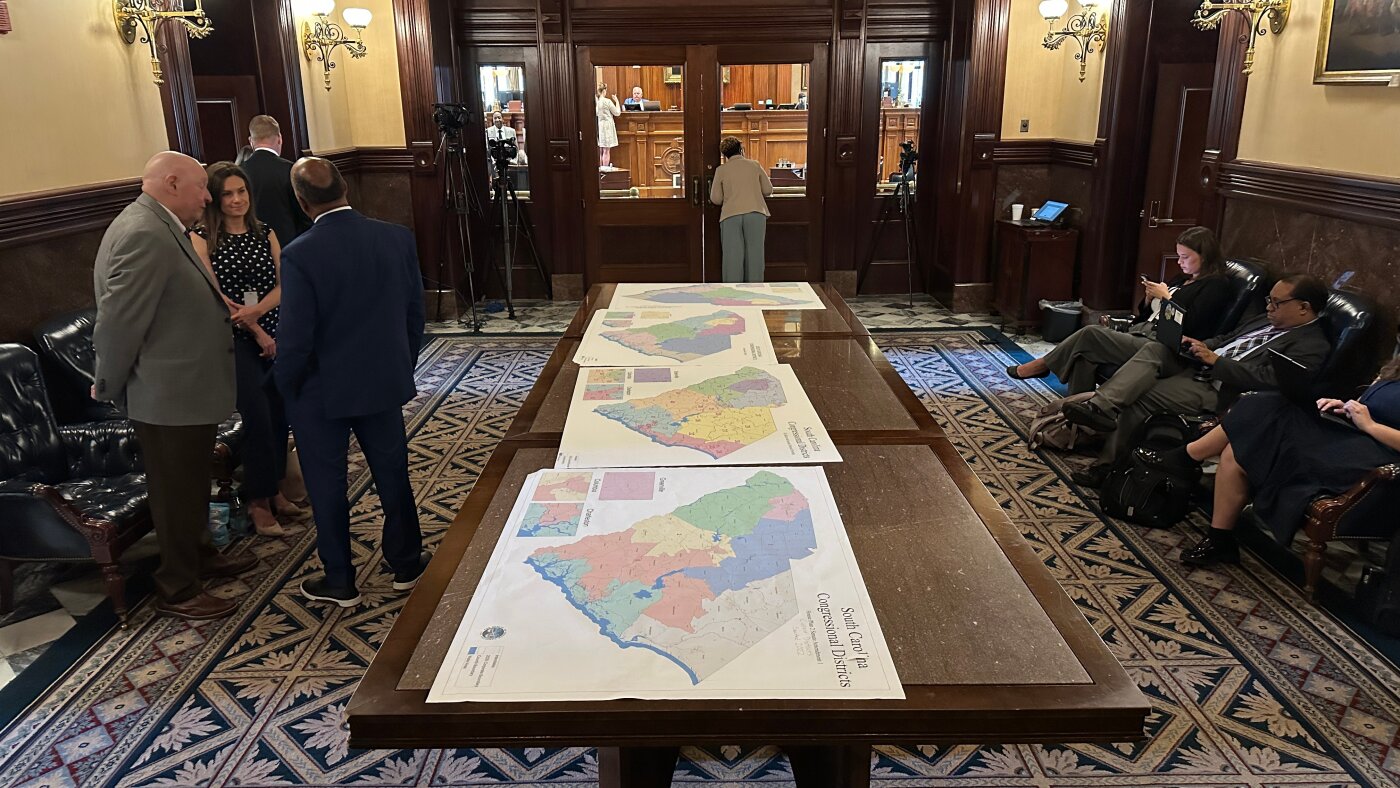
Maps for new South Carolina congressional districts are shown in the state Senate antechamber on Friday.
Jeffrey Collins/AP
hide caption
toggle caption
Jeffrey Collins/AP
South Carolina lawmakers dealt President Trump’s national redistricting effort a blow Tuesday when the state Senate voted against redistricting there after three weeks of rushed hearings and long debate.
Trump had been pushing state Republicans to redraw voting lines so they could flip a seat currently held by Democratic Rep. Jim Clyburn. It would have made all the state’s seven congressional districts lean Republican and it would have extended the GOP lead in the national redistricting race, already netting them around nine more seats in the U.S. House.
Early voting in the June 9 primary had started Tuesday morning and was one factor some Republican senators cited for opposing the redistricting, which had dragged on through weeks of on-and-off debate.
A move to bring the bill to a vote failed in the Senate when 12 Republicans joined 12 Democrats on a key procedural vote to block the 26 votes needed to end debate and bring up a vote on the bill. A second procedural vote fell even more short.
The state Senate is not up for election this year
Several Republicans moved to the opposition saying that changing the map could disenfranchise some voters. Around 26,000 voters cast ballots within the first several hours of polls opening, putting Tuesday on track to break early primary voting records.
Republican state Sen. Richard Cash echoed that concern from the floor Tuesday and said time had run out.
“Voting has begun, it is time to conclude the matter,” Cash said. “I know there’s going to be a lot of anger and frustration that we did not get the job done. I get it. Many of us are also frustrated and disappointed at what is a very unsatisfying outcome.”

Unlike members of the House, senators are not up for reelection this year and that could give them some insulation from pressure from Trump, who generated primary challenges against Republicans elsewhere for opposing redistricting.
Earlier Tuesday, Clyburn cast his ballot early in Orangeburg, a city 45 miles southeast of Columbia, and told reporters he was set to run in whatever district they draw him into. “I am embarrassed that so many people in our legislature will allow strangers in Washington to tell them what to do, when to do it, and how to do it,” Clyburn said.
Trump and Republicans still hold an advantage in the redistricting battle
Overall, Trump and the Republicans have gained in the unprecedented, mid-decade redistricting push he started. Republicans hold just a few-seats advantage in the House and the party in the White House usually loses seats in midterms. Usually, states redistrict at the start of the decade after the census count.
Redistricting across the country has given Republicans an advantage in about 15 more seats to the Democrats’ six That would net the Republicans about nine seats, while some court challenges remain that could alter that figure.
Trump got Texas Republicans to redistrict last summer. California Democrats, backed by a public vote, countered that. But since then it’s been mostly Republicans’ gains as they control more legislatures and many Democratic-led states are constrained by laws against gerrymandering.
South Carolina Senate Majority Leader Shane Massey, who fielded several calls from Trump, was one of those Republicans opposing the redistricting. He said that unlike other southern states that rushed to redistrict, South Carolina’s districts did not fall under a recent Supreme Court ruling weakening voting rights for minorities.
Also on Tuesday, a federal court temporarily blocked the redistricting plan Alabama lawmakers had approved to flip a Democratic-held seat there. The court ruling is expected to be challenged at the U.S. Supreme Court, which has earlier backed the redistricting plan.


When you look at several Republicans moved to the opposition saying that changing the map could disenfranchise some voters, the implications are hard to ignore.
Jeffrey Collins is in a tough spot here, curious how they navigate it.
When you look at trump had been pushing state Republicans to redraw voting lines so they could flip a seat currently held by Democratic Rep, the implications are hard to ignore.
Reading that a move to bring the bill to a vote failed in the Senate when 12 Republicans joined 12 Democrats on a key procedural vote to block the 26 votes needed to end debate and bring up a vote on the bill — hard to argue with the logic there.
Basically a move to bring the bill to a vote failed in the Senate when 12 Republicans joined 12 Democrats on a key procedural vote to block the 26 votes needed to end debate and bring up a vote on the bill. What matters is whether anything changes because of it.
The bigger issue here is several Republicans moved to the opposition saying that changing the map could disenfranchise some voters. That changes the calculation.
On one hand several Republicans moved to the opposition saying that changing the map could disenfranchise some voters. But at the same time republican state Sen. Richard Cash echoed that concern from the floor Tuesday and said time had run out.
Jeffrey Collins has been pushing this agenda for a while now.
Considering trump had been pushing state Republicans to redraw voting lines so they could flip a seat currently held by Democratic Rep, it raises some real questions about what happens next.
If trump had been pushing state Republicans to redraw voting lines so they could flip a seat currently held by Democratic Rep, then the bigger picture starts to look very different.
The fact that maps for new South Carolina congressional districts are shown in the state Senate antechamber on Friday really puts things into perspective.
What stands out is republican state Sen. Richard Cash echoed that concern from the floor Tuesday and said time had run out. That is the part worth paying attention to.
Basically trump had been pushing state Republicans to redraw voting lines so they could flip a seat currently held by Democratic Rep. What matters is whether anything changes because of it.
So the bottom line is a move to bring the bill to a vote failed in the Senate when 12 Republicans joined 12 Democrats on a key procedural vote to block the 26 votes needed to end debate and bring up a vote on the bill. Wonder how this will land.
Think about it: republican state Sen. Richard Cash echoed that concern from the floor Tuesday and said time had run out. That speaks volumes.