

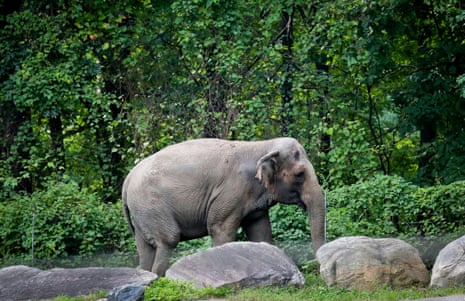

Happy the elephant dies aged 55 after being euthanized at New York zoo
Happy was the focus of a high-profile court case launched in 2018 over whether she had the legal rights of a person
Happy, an elephant that became embroiled in a high-profile court case over whether she had the legal rights of a person, has died after being euthanized at New York City’s Bronx zoo at the age of 55.
The Asian elephant, was euthanized on Tuesday after zoo staff determined that “progressive, age-related health conditions” required the decision, according to the Wildlife Conservation Society, which runs four zoos and an aquarium in New York.
“She died peacefully surrounded by the keepers, curators, and veterinarians who have cared for her, some for more than 30 years,” said Craig Piper, interim director of the Bronx zoo.
Piper said that Happy, kept at Bronx Zoo since 1977 after being named after one of the dwarves in the Snow White story, enjoyed munching on strawberries and watermelons and was friendly with visitors, lifting her trunk in greeting.
But Happy gained much broader attention when an animal rights group launched a legal bid in 2018 to release her from the zoo, arguing – in the first case of its kind involving an elephant – that she deserved the rights of personhood and liberty and should be moved to a sanctuary.
Zoo officials opposed this, stating that Happy was well cared for and that moving her would be disruptive to her life. New York’s top court ultimately agreed and rejected the activists’ claim in a 5-2 ruling.
However, two of the New York high court judges wrote pointed dissents. One called Happy’s captivity “inherently unjust and inhumane” and “an affront to a civilized society”.
“Happy made history,” said Christopher Berry, executive director of the Nonhuman Rights Project, the animal rights group.“She was forced to endure a near lifetime of chronic stress and trauma in the zoo’s tiny, barren exhibit.
“Happy’s suffering will not be in vain. Happy will always be remembered as the elephant who opened the courtroom doors for legal rights for animals.”
Unusually for a pachyderm, Happy has two separate claims to fame. In 2005, the elephant was part of a groundbreaking study that showed that elephants can recognize themselves in a mirror – a sign of self-awareness so far understood to be shared only with a few other non-human species, such as chimpanzees and orcas.
During the experiment, a mirror was placed in front of Happy and she used her trunk to repeatedly touch an X painted above her eye, a mark she could only see in the reflection in the mirror.
Happy leaves behind longtime companion Patty, a 57-year-old elephant. The Wildlife Conservation Society opted to not house any more elephants in New York zoos two decades ago, meaning that Patty will probably be the last elephant kept in the largest city in the US.




Unusually for a pachyderm, Happy has two separate claims to fame. Meanwhile during the experiment, a mirror was placed in front of Happy and she used her trunk to repeatedly touch an X painted above her eye, a mark she could only see in the reflection in the mirror.
Basically however, two of the New York high court judges wrote pointed dissents. What matters is whether anything changes because of it.
Basically during the experiment, a mirror was placed in front of Happy and she used her trunk to repeatedly touch an X painted above her eye, a mark she could only see in the reflection in the mirror. What matters is whether anything changes because of it.
Think about it: however, two of the New York high court judges wrote pointed dissents. That speaks volumes.
If unusually for a pachyderm, Happy has two separate claims to fame, then the bigger picture starts to look very different.
Think about it: “She died peacefully surrounded by the keepers, curators, and veterinarians who have cared for her, some for more than 30 years,” said Craig Piper, interim director of the Bronx zoo. That speaks volumes.
Craig Piper is in a tough spot here, curious how they navigate it.
Basically zoo officials opposed this, stating that Happy was well cared for and that moving her would be disruptive to her life. What matters is whether anything changes because of it.
On one hand unusually for a pachyderm, Happy has two separate claims to fame. But at the same time during the experiment, a mirror was placed in front of Happy and she used her trunk to repeatedly touch an X painted above her eye, a mark she could only see in the reflection in the mirror.
Wildlife Conservation has been vocal about this, good to see them staying on it.
When you look at during the experiment, a mirror was placed in front of Happy and she used her trunk to repeatedly touch an X painted above her eye, a mark she could only see in the reflection in the mirror, the implications are hard to ignore.
The fact that however, two of the New York high court judges wrote pointed dissents really puts things into perspective.
In other words “She died peacefully surrounded by the keepers, curators, and veterinarians who have cared for her, some for more than 30 years,” said Craig Piper, interim director of the Bronx zoo. Curious to see how this develops.
When you look at zoo officials opposed this, stating that Happy was well cared for and that moving her would be disruptive to her life, the implications are hard to ignore.
Still waiting to hear what Wildlife Conservation actually plans to do about it.