


Luigi Mangione appears in court over healthcare CEO’s killing with trial a month away
Prosecutors allege that Mangione gunned down Brian Thompson outside New York City hotel in December 2024
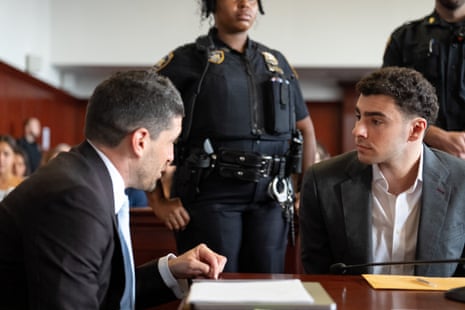
Luigi Mangione, who is accused of the killing of the UnitedHealthcare CEO Brian Thompson, appeared Tuesday morning at Manhattan state court for a pre-trial conference.
Mangione was escorted into court at 9.46am. He wore a slate-colored suit and a white shirt.
Mangione’s appearance comes less than a month before the start of his highly anticipated 8 September trial. Prosecutors allege that Mangione gunned down Thompson outside a Midtown Manhattan hotel on 4 December 2024.
Mangione, 28, who was arrested at a Pennsylvania McDonald’s several days later, maintains his innocence. He also faces a federal trial on stalking charges related to Thompson’s killing.
Judge Gregory Carro’s courtroom was nearly packed for this proceeding, with almost two dozen apparent Mangione supporters in attendance. Some of these supporters wore electric green wrist bands that looked akin to the paper-and-adhesive bracelets that convey admission to a club or concert.
One woman wore a black T-shirt with white letters stating “OPEN THE COURTROOM”, which referred to a controversy over an overflow courtroom and video feed.
The case has captured international audiences because Thompson’s death reignited discourse on the US’s for-profit healthcare system – as well as Mangione’s ascent to folk-hero status among some of his supporters, enabled by social media.
This attention has caused concern that Mangione’s trial could devolve into a circus but after Carro took the bench, it appeared that a solution may have been found. The original Mangione trial media access plan did not include an overflow room to accommodate public or press interest, but Carro announced that there would be an overflow room to provide more seating.
Prior to the conference this morning, both Mangione’s defense and prosecutors had traded barbs over media access.
Mangione’s lawyers claimed, without citing any specific evidence, that state court officials and prosecutors developed a media plan, including which reporters would have seats, without consulting the defense. Media reports swiftly debunked this claim, as the prosecution does not have a role in determining seating.
Prosecutors said they neither had a role in determining reporters nor the preclusion of an overflow room. The defense later submitted another letter clarifying its position, but continued to request a hearing on the media access issue.
About the Author