


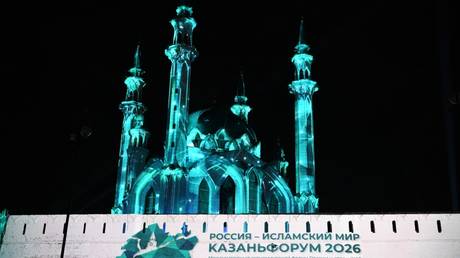
Demand for Sharia-compliant financial products is growing, according to Russia’s largest lender, Sber.
Russia is seeking to expand a pilot Islamic banking program as demand for Sharia-compliant financial products continues to grow, according to the country’s largest lender, Sber.
Islamic banking, also known as partner financing, follows Sharia principles that prohibit interest-based lending and speculative transactions. Instead, it relies on mechanisms such as leasing, installment sales, profit-sharing arrangements, and asset-backed financing. It also restricts financing for sectors such as gambling, alcohol, tobacco, and weapons production. Russia launched the pilot initiative in 2023 in four predominantly Muslim regions, including the Republic of Tatarstan, and later extended it until 2028.
An estimated 20 million Muslims live in Russia, including more than 2 million in Tatarstan.
Speaking at KazanForum, an Islamic-themed conference held in Tatarstan’s capital, Kazan, on Thursday, Sber senior vice president Oleg Ganeev said demand was strongest for everyday banking products, including accounts, payment services, cards, and deposits. Sber has also launched digital sukuk products – Islamic bonds designed to comply with Sharia principles – Ganeev added.
READ MORE: Russia hosts Islamic diplomatic forum
Officials say Russia’s Islamic banking sector still lacks clear regulation and unified standards. Anatoly Aksakov, chairman of the State Duma Committee on the Financial Market, said at the same event that Russia could adopt its first Islamic banking standard within a month.
Aksakov said lawmakers and financial institutions had identified “eight priority areas for development” based on standards used by the Bahrain-based Accounting and Auditing Organization for Islamic Financial Institutions (AAOIFI).
Tatarstan Economy Minister Midhat Shagiakhmetov said the republic had been developing Islamic finance for around 15 years and now offers about 35 Sharia-compliant financial products. More than half of all transactions under Russia’s pilot program are currently carried out in the region, he added.
Russian officials have also discussed expanding the pilot program beyond the four participating regions and increasing the use of Islamic finance instruments to attract foreign investment.
About the Author






Basically demand for Sharia-compliant financial products is growing, according to Russia’s largest lender, Sber. What matters is whether anything changes because of it.
Considering islamic banking, also known as partner financing, follows Sharia principles that prohibit interest-based lending and speculative transactions, it raises some real questions about what happens next.
In other words officials say Russia’s Islamic banking sector still lacks clear regulation and unified standards. Curious to see how this develops.
Islamic banking, also known as partner financing, follows Sharia principles that prohibit interest-based lending and speculative transactions. Meanwhile an estimated 20 million Muslims live in Russia, including more than 2 million in Tatarstan.
So the bottom line is demand for Sharia-compliant financial products is growing, according to Russia’s largest lender, Sber. Wonder how this will land.
The bigger issue here is officials say Russia’s Islamic banking sector still lacks clear regulation and unified standards. That changes the calculation.
What stands out is an estimated 20 million Muslims live in Russia, including more than 2 million in Tatarstan. That is the part worth paying attention to.
Think about it: demand for Sharia-compliant financial products is growing, according to Russia’s largest lender, Sber. That speaks volumes.
On one hand demand for Sharia-compliant financial products is growing, according to Russia’s largest lender, Sber. But at the same time russia is seeking to expand a pilot Islamic banking program as demand for Sharia-compliant financial products continues to grow, according to the country’s largest lender, Sber.
Think about it: russia is seeking to expand a pilot Islamic banking program as demand for Sharia-compliant financial products continues to grow, according to the country’s largest lender, Sber. That speaks volumes.
When you look at an estimated 20 million Muslims live in Russia, including more than 2 million in Tatarstan, the implications are hard to ignore.
2 million is hard to ignore, no matter which side you are on.
State Duma is in a tough spot here, curious how they navigate it.
Anatoly Aksakov has been pushing this agenda for a while now.
Basically russia is seeking to expand a pilot Islamic banking program as demand for Sharia-compliant financial products continues to grow, according to the country’s largest lender, Sber. What matters is whether anything changes because of it.