

US threatens to revoke the Palestinian UN ambassador’s visa


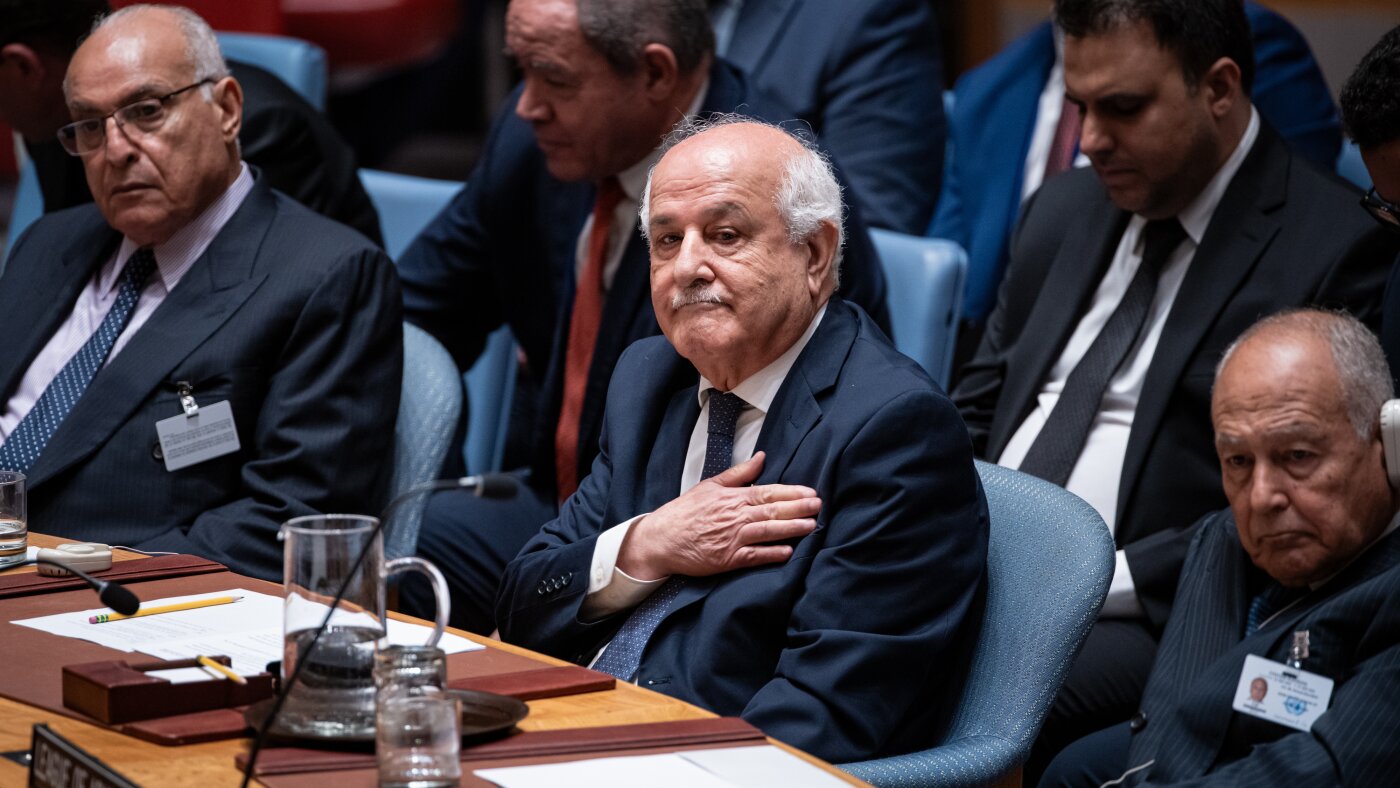
Palestinian Ambassador to the United Nations Riyad Mansour pats his heart during the Kuwait Crown Prince’s address at the High-Level Security Council meeting on Palestinians and Israel during the 80th session of the United Nations General Assembly, Sept. 23, 2025
Angelina Katsanis/AP
hide caption
toggle caption
Angelina Katsanis/AP
TEL AVIV — The U.S. is threatening to revoke the visas of the Palestinian delegation to the United Nations unless the Palestinian ambassador to the U.N. withdraws his run for vice president of the General Assembly.
A U.S. State Department cable issued Tuesday and obtained by NPR instructs U.S. diplomats in Jerusalem to pressure Palestinian officials this week to withdraw their bid for one of the 21 vice president roles at the U.N., or face possible consequences including visa revocation.
The May 19 U.S. cable, marked sensitive but unclassified, says Palestinian ambassador Riyad Mansour “has a history of accusing Israel of genocide,” and that his bid “fuels tension” and undermines President Trump’s peace plan for Gaza.
“A bully pulpit for Mansour would not improve the lives of Palestinians and would significantly damage U.S. relations with the PA [Palestinian Authority]. Congress will take it extremely seriously,” the cable says.
Palestinian Authority President Mahmoud Abbas’ office declined comment.
“It would be unfortunate,” the U.S. cable says in a threat to revoke visas
Ahead of last year’s U.N. General Assembly in New York, the Trump Administration made the rare move of denying U.S. visas to top Palestinian officials including President Abbas. But the U.S. did not revoke visas for the Palestinian delegation to the U.N.
“In September 2025, the Department made the decision to waive visa sanctions and other inadmissibilities for Palestinian officials assigned to the PLO’s UN Observer Mission in New York. It would be unfortunate to have to revisit any available options,” the May 19 cable says.
A former U.S. diplomat calls visa revocation “counterproductive”
For decades, the U.S. under both Democratic and Republican administrations has opposed Palestinian attempts to gain full membership at the U.N. and international bodies, arguing they were unilateral moves that undermined peace efforts with Israel.
But the U.S. threat to revoke Palestinian diplomats’ visas at the U.N. is unprecedented.
Hady Amr, who served as a senior U.S. State Department official on Palestinian affairs under the Obama and Biden administrations, criticized the decision to threaten visa restrictions.
“Short of extreme situations like Russian espionage or election interference, using visa restrictions as you are reporting is extremely rare,” Amr told NPR. “Generally, it’s counterproductive because you need diplomats to work out problems between countries and by expelling diplomats, you’re undermining not only their ability to solve problems, but the abilities of the United States as well.”
The State Department did not immediately respond to an NPR request for comment.
The Palestinian ambassador already withdrew his presidency bid
In February, Palestinian ambassador Mansour withdrew a bid for president of the U.N. General Assembly. The U.S. had lobbied him to drop the bid, according to the U.S. cable.
Israel’s ambassador to the U.N. celebrated Mansour’s decision to drop the bid.
“From the outset, the very submission of the candidacy was yet another attempt to turn the UN General Assembly into a political circus against Israel and to bolster the status of the Palestinian delegation through the back door,” Israeli U.N. Ambassador Danny Danon said in a statement on X. “Instead, the Palestinian delegation should start focusing on stopping incitement of terrorism and on actually reforming the Palestinian Authority.”
Elections for the vice president roles are on June 2. U.S. officials have been repeatedly appealing to the Palestinian delegation not to run in that race.
The Palestinian ambassador is on a list of countries in Asia and the Pacific running in the race, including Afghanistan, Iraq and Mongolia, according to La Neice Collins, spokesperson of the office of the President of the U.N. General Assembly.
The U.S. cable says the next General Assembly president could ask a Palestinian vice president to preside over high-profile U.N. sessions.
The cable called that a “worst-case scenario.”
NPR’s Michele Kelemen in Washington contributed to this report.
Michele Kelemen in Washington contributed to this report


Kuwait Crown has been pushing this agenda for a while now.
Kuwait Crown has been vocal about this, good to see them staying on it.
Considering tEL AVIV — The U.S. is threatening to revoke the visas of the Palestinian delegation to the United Nations unless the Palestinian ambassador to the U.N, it raises some real questions about what happens next.
What stands out is ahead of last year’s U.N. General Assembly in New York, the Trump Administration made the rare move of denying U.S. That is the part worth paying attention to.
What stands out is “In September 2025, the Department made the decision to waive visa sanctions and other inadmissibilities for Palestinian officials assigned to the PLO’s UN Observer Mission in New York. That is the part worth paying attention to.
The fact that a U.S. State Department cable issued Tuesday and obtained by NPR instructs U.S really puts things into perspective.
So the bottom line is a U.S. State Department cable issued Tuesday and obtained by NPR instructs U.S. Wonder how this will land.
On one hand ahead of last year’s U.N. General Assembly in New York, the Trump Administration made the rare move of denying U.S. But at the same time “In September 2025, the Department made the decision to waive visa sanctions and other inadmissibilities for Palestinian officials assigned to the PLO’s UN Observer Mission in New York.
In other words ahead of last year’s U.N. General Assembly in New York, the Trump Administration made the rare move of denying U.S. Curious to see how this develops.
Considering ahead of last year’s U.N. General Assembly in New York, the Trump Administration made the rare move of denying U.S, it raises some real questions about what happens next.
If tEL AVIV — The U.S. is threatening to revoke the visas of the Palestinian delegation to the United Nations unless the Palestinian ambassador to the U.N, then the bigger picture starts to look very different.
Basically “A bully pulpit for Mansour would not improve the lives of Palestinians and would significantly damage U.S. What matters is whether anything changes because of it.
TEL AVIV — The U.S. is threatening to revoke the visas of the Palestinian delegation to the United Nations unless the Palestinian ambassador to the U.N. Meanwhile a U.S. State Department cable issued Tuesday and obtained by NPR instructs U.S.
Basically a U.S. State Department cable issued Tuesday and obtained by NPR instructs U.S. What matters is whether anything changes because of it.
The detail about a U.S. State Department cable issued Tuesday and obtained by NPR instructs U.S is something people should sit with.