


What’s in the Democrats’ 2024 election autopsy report, and what’s left out?
Report contains damning findings concerning spending, media strategy and organizing failures that led to defeat
A sweeping internal review of the Democrats’ 2024 election losses runs nearly 200 pages. The autopsy report, released on Thursday after months of speculation and delay, was meant to capture why and how the Democrats lost the White House and collapsed electorally nationwide.
Along with a slew of mistakes, it contains some damning findings that examine spending patterns, media strategy, voter contact and organizing failures across the ballot, describing a party that has lost ground at every level of government for nearly two decades.
But the report also manages to avoid almost every question the party’s voters are actually asking about the consequential decisions of the cycle.
Here is what is and what is not in the report:
-
1. What’s not in it: Joe Biden staying in the race for as long as he did
The decision by Biden – and the party apparatus around him – to seek re-election despite evident cognitive decline and alarm over his old age, and the months following in which donors, elected officials and senior Democrats privately acknowledged concerns they refused to raise publicly, goes entirely unexamined.
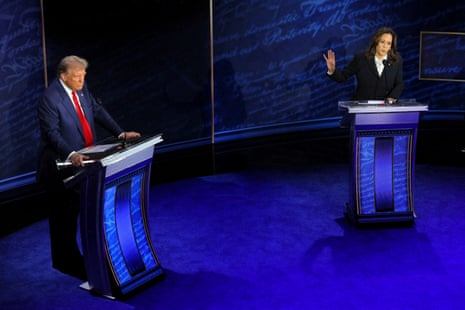
Meanwhile, Harris became the Democratic nominee without a single primary vote being cast in her favor.
While switching Harris in was credited in the report with boosting down-ballot Democrats, the candidate anointment is treated as an event that happened to the party rather than a crisis the party created and then managed badly.
-
2. What’s not in it: Gaza, at all
Your control+F is not broken: in the nearly 200 pages of reporting, the words “Gaza” and “Israel” do not appear.
During the Michigan primary in 2024, the “uncommitted” protest movement drew more than 100,000 votes in a state Biden had won by about 154,000 in 2020, and Harris would lose by about 100,000.
After the election loss, one poll from YouGov/IMEU Policy Project found the top concern nationally for 2020 Biden voters who didn’t go for Harris in 2024 was “ending Israel’s violence in Gaza”. Another post-election poll said more than a third of Harris voters said they knew someone who didn’t vote for her because of Gaza, according to Data for Progress.
-
3. What’s not in it: Kamala Harris’s identity
The report analyzes the male voter gap, the suburban voter gap, the rural voter gap and the Latino voter shift in considerable detail.
It never once examines whether Harris’s race and gender shaped media coverage, voter perception, or the specific lines of attack deployed against her – even as it implicitly acknowledges that she faced a uniquely difficult environment as a candidate.
-
4. What’s not in it: Joe Rogan
While the report devotes considerable space to the Democrats’ failure to reach young men on digital platforms, their over-reliance on legacy broadcast media and the need to meet voters “where they are”. Trump’s appearance on the Rogan podcast was one of the most-watched political interviews of the year, reaching an audience of millions of exactly the kind of voters Democrats lost.
The decision not to accept a similar invitation (reportedly declined by the Harris campaign) is not mentioned once.
-
5. What’s in it: $150m was spent on voter contact in the $2bn campaign
The report states that “campaign leadership estimated around $150m was invested on voter contact”, then notes that this “is simply too small a piece of the pie”.
In comparison, the campaign invested “$1.04bn in media expenditures”. Under the party’s own traditional budget frameworks, voter contact spending should have been closer to $300m.
The gap, the report suggests, reflected an outdated “strategy of scarcity” that no longer made sense given the amount of money available.
-
6. What’s in it: no research on Kamala Harris, while pollsters in the dark
Perhaps the most damning words in the document: “An incumbent vice-president. With no research to share once she became the nominee.”
The report reveals that when Kamala Harris entered the race, her own team discovered “there was no self-research on the vice-president to guide the development of the research instruments”. The White House, it concludes, “did not position or prepare the vice-president”, calling it “a massive missed opportunity”.
And in a remarkable admission, the report reveals that the Harris campaign’s internal polling team did not see advertisements before they aired. They learned about them, in some cases, by reading the press.
-
7. What’s in it: annotations
One notable feature of the report is that it is filled with annotations about the claims contained in the report.
At the top of each page, a red disclaimer reads: “This document reflects the views of the author, not the DNC. The DNC was not provided with the underlying sourcing, interviews or supporting data for many of the assertions contained herein and therefore cannot independently verify the claims presented.”
Elsewhere in the document, annotations raise concerns about the accuracy of the findings. Under the subhead “WHAT HAPPENED (ELECTORAL REVIEW)”, on page 21, an annotation reads “no evidence for many claims in this section”. Other sections include annotations that state that “public reporting and data contradict several underlying assumptions”, “claim contradicts public reporting”, “methodology appears internally inconsistent” and “numbers appear inaccurate based on public data”.
Other annotations note that some sections, such as the “conclusion” section, were “not provided by the author”.
In a lengthy statement on Thursday along with the release of the report, Ken Martin, the DNC chair, said that he released the report as he received it “in its entirety, unedited unabridged – with annotations for claims that couldn’t be verified”.
-
8. What’s in it: the male voter collapse was solvable
North Carolina’s governor, Josh Stein, won 51% of male voters in the same election in which Harris won just 40%. The report acknowledges this gap directly, suggesting the national campaign’s approach to male voters – particularly young men of color – was a strategic choice that failed, not an inevitable demographic shift.
Anna Betts contributed reporting from New York



So the bottom line is meanwhile, Harris became the Democratic nominee without a single primary vote being cast in her favor. Wonder how this will land.
The bigger issue here is a sweeping internal review of the Democrats’ 2024 election losses runs nearly 200 pages. That changes the calculation.
The fact that a sweeping internal review of the Democrats’ 2024 election losses runs nearly 200 pages really puts things into perspective.
Your control+F is not broken: in the nearly 200 pages of reporting, the words “Gaza” and “Israel” do not appear. Meanwhile during the Michigan primary in 2024, the “uncommitted” protest movement drew more than 100,000 votes in a state Biden had won by about 154,000 in 2020, and Harris would lose by about 100,000.
If but the report also manages to avoid almost every question the party’s voters are actually asking about the consequential decisions of the cycle, then the bigger picture starts to look very different.
Reading that a sweeping internal review of the Democrats’ 2024 election losses runs nearly 200 pages — hard to argue with the logic there.
What stands out is but the report also manages to avoid almost every question the party’s voters are actually asking about the consequential decisions of the cycle. That is the part worth paying attention to.
When you look at meanwhile, Harris became the Democratic nominee without a single primary vote being cast in her favor, the implications are hard to ignore.
The bigger issue here is meanwhile, Harris became the Democratic nominee without a single primary vote being cast in her favor. That changes the calculation.
Still waiting to hear what Policy Project actually plans to do about it.
Basically during the Michigan primary in 2024, the “uncommitted” protest movement drew more than 100,000 votes in a state Biden had won by about 154,000 in 2020, and Harris would lose by about 100,000. What matters is whether anything changes because of it.
Reading that meanwhile, Harris became the Democratic nominee without a single primary vote being cast in her favor — hard to argue with the logic there.
Basically but the report also manages to avoid almost every question the party’s voters are actually asking about the consequential decisions of the cycle. What matters is whether anything changes because of it.
Think about it: meanwhile, Harris became the Democratic nominee without a single primary vote being cast in her favor. That speaks volumes.
Kamala Harris has been pushing this agenda for a while now.