

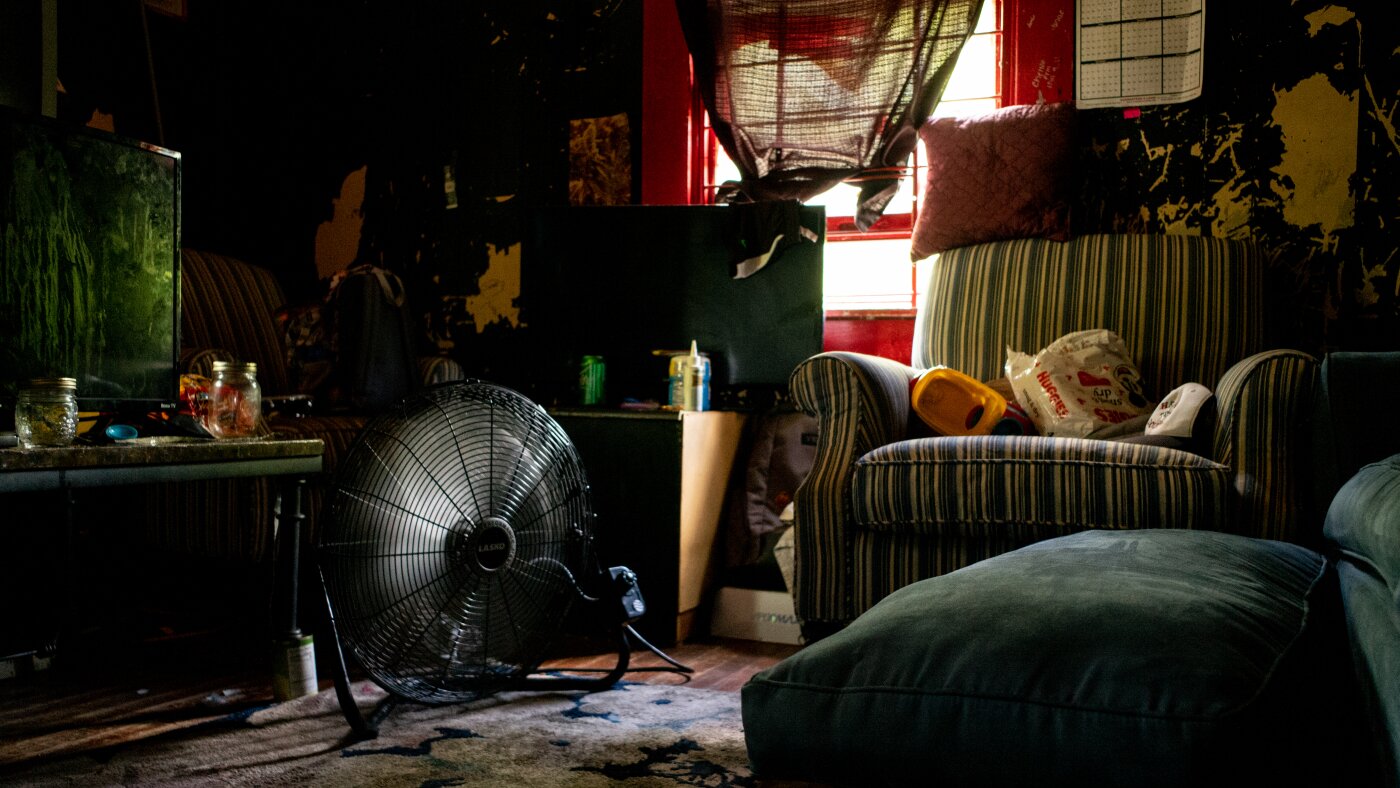
Summer electric bills sizzle as the cost of cooling climbs


Electricity prices are climbing faster than overall inflation. That, coupled with a hotter-than-usual summer, has forecasters warning of a sharp jump in utility bills.
Brandon Bell/Getty Images
hide caption
toggle caption
Brandon Bell/Getty Images
Temperatures are climbing, and so is the price of electricity. That’s a one-two punch that could result in sharply higher utility bills this summer.
“Climate scientists think this could be the hottest summer on record or at least close to it,” says Mark Wolfe, who heads the National Energy Assistance Directors Association (NEADA). “So families need to use more of an increasingly expensive product to stay cool this summer. And that’s going to be tough.”
NEADA is projecting that electricity bills will be 8.5% higher this summer than last, on average, with residents in some Southern states seeing even bigger increases.
Robin Westphal lives about halfway between Houston and Galveston, Texas, where the feels-like temperature in midsummer can easily soar past 100 degrees.

“It’s very difficult to come here and try to breathe with this kind of humidity and hot weather,” Westphal says.
Even though her home is insulated well, Westphal says, her summer air-conditioning bills topped $300 a month last year. She’s bracing for higher-priced power this year, so she and her husband are cutting corners elsewhere.
“We might not be able to spend as much at the grocery store,” says Westphal, a third-grade math teacher. “Maybe not going out to eat. Limiting our extra activities.”
In northwest Arkansas, seminary student Matthew Kolb has taken to donating plasma twice a week to help cover his bills, which include about $250 a month for electricity. Kolb says money is tight even though he has a full-time job and serves in the Army Reserve.
“We have two kids under 2,” Kolb says, noting that his wife and older daughter are especially sensitive to the heat. “Higher utilities in the summer always stretches us a little bit and makes budgeting a little more of a complicated feat.”
Nationwide, the cost of a kilowatt-hour has risen faster than overall inflation: more than 6% in the last year and 39% in the last five years. What’s more, in many parts of the U.S., customers will have to buy more kilowatt-hours this summer, as extra-hot weather from El Niño keeps fans and air conditioners working overtime.
The federal government provides some help to low-income families to pay their utility bills. But funding for that program, known as LIHEAP, has been flat for the last three years, even as the cost of electricity has risen sharply.
“The combination of [higher-priced] natural gas, rebuilding the grid, data centers are all pushing up the price of electricity,” Wolfe says.
Energy assistance offices are increasingly hearing from middle-income families who are struggling to pay their power bills. Delia Anderson, who runs the Economic Opportunity Agency, a nonprofit that distributes aid in 10 Arkansas counties, says electricity is just one of many expenses that families are having to juggle.
“Gas prices are rising. Groceries are higher. So it is compounded by electricity costs,” Anderson says. “We’re going to see energy use increasing because it’s hot.”
Every year, some 13 million customers in the U.S. fall so far behind on their bills that their power is temporarily cut off. Some states limit power shut-offs on the hottest days of the summer, but most have no such restriction.
In Texas, utilities are investing in upgrades to the power grid so it can better withstand extreme weather and meet the growing demand from power-hungry data centers. That’s contributing to higher costs, however. And Westphal still worries about rolling power outages, which are all too common when the temperature gets too high.
“If it’s during the day, it’s miserable,” she says. “We ended up buying a generator. That’s beneficial, but we did have to spend money so we can survive in the heat if the power goes off.”
Westphal is not expecting much relief until cooler weather arrives sometime around mid-October.



The bigger issue here is temperatures are climbing, and so is the price of electricity. That changes the calculation.
Brandon Bell has been pushing this agenda for a while now.
So the bottom line is says Mark Wolfe, who heads the National Energy Assistance Directors Association (NEADA). Wonder how this will land.
Reading that says Mark Wolfe, who heads the National Energy Assistance Directors Association (NEADA) — hard to argue with the logic there.
The fact that electricity prices are climbing faster than overall inflation really puts things into perspective.
Basically nEADA is projecting that electricity bills will be 8.5% higher this summer than last, on average, with residents in some Southern states seeing even bigger increases. What matters is whether anything changes because of it.
Basically robin Westphal lives about halfway between Houston and Galveston, Texas, where the feels-like temperature in midsummer can easily soar past 100 degrees. What matters is whether anything changes because of it.
What stands out is robin Westphal lives about halfway between Houston and Galveston, Texas, where the feels-like temperature in midsummer can easily soar past 100 degrees. That is the part worth paying attention to.
The detail about robin Westphal lives about halfway between Houston and Galveston, Texas, where the feels-like temperature in midsummer can easily soar past 100 degrees is something people should sit with.
When you look at says Mark Wolfe, who heads the National Energy Assistance Directors Association (NEADA), the implications are hard to ignore.
What stands out is says Mark Wolfe, who heads the National Energy Assistance Directors Association (NEADA). That is the part worth paying attention to.
In other words robin Westphal lives about halfway between Houston and Galveston, Texas, where the feels-like temperature in midsummer can easily soar past 100 degrees. Curious to see how this develops.
Considering nEADA is projecting that electricity bills will be 8.5% higher this summer than last, on average, with residents in some Southern states seeing even bigger increases, it raises some real questions about what happens next.
Says Mark Wolfe, who heads the National Energy Assistance Directors Association (NEADA). Meanwhile nEADA is projecting that electricity bills will be 8.5% higher this summer than last, on average, with residents in some Southern states seeing even bigger increases.
When you look at electricity prices are climbing faster than overall inflation, the implications are hard to ignore.