

California chemical tank has cracked causing state of emergency, thousands to evacuate


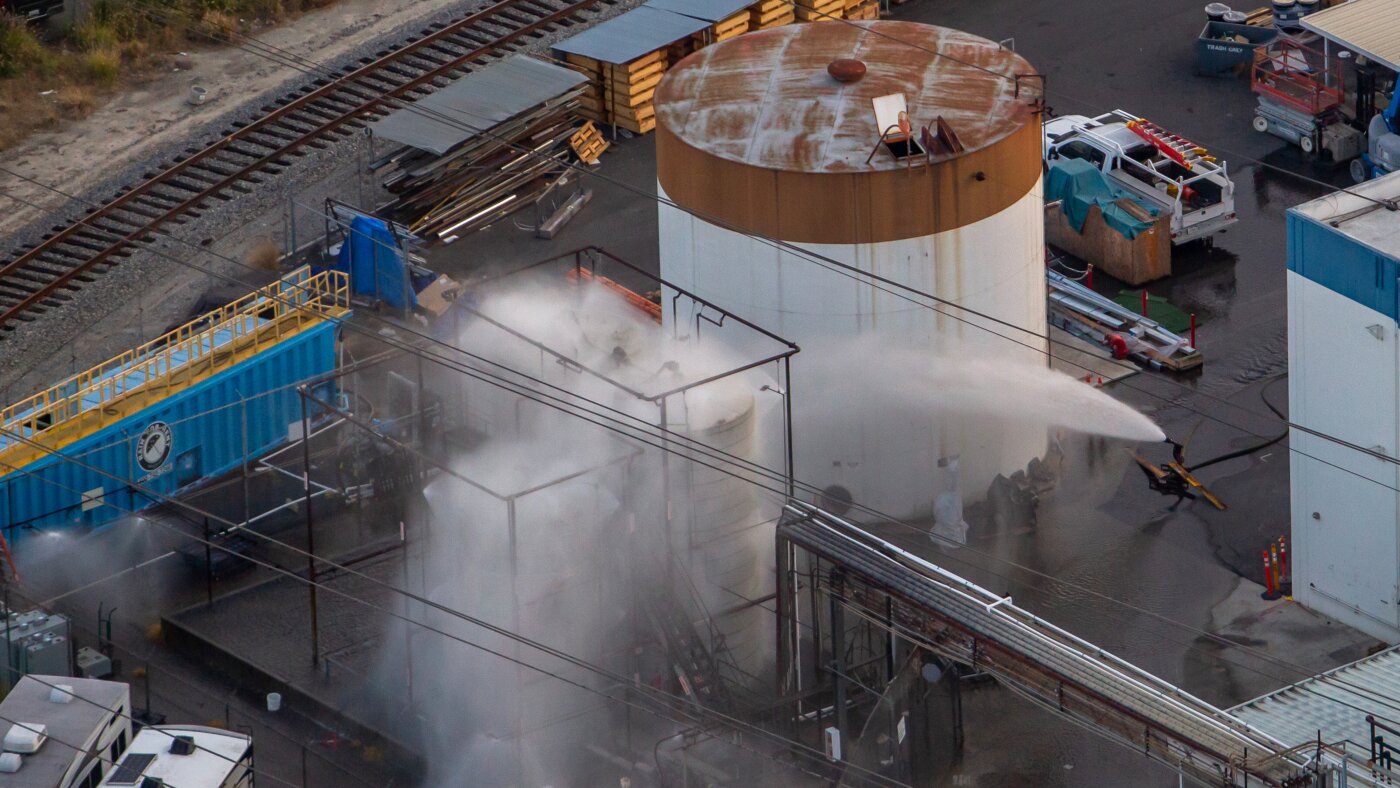
An aerial view of water being sprayed onto an overheated 34,000-gallon tank at GKN Aerospace on May 23, 2026 in Garden Grove, California. A malfunctioning tank at an aerospace plant has the potential of a chemical leak or explosion.
Apu Gomes/Getty Images
hide caption
toggle caption
Apu Gomes/Getty Images
Some 50,000 residents of Garden Grove, California remain under an evacuation order Sunday as emergency response teams struggle to deal with a potentially explosive situation at a nearby aerospace manufacturing plant.
Here’s the latest on what’s happening at the plant, and what could yet come.
Overnight, the chemical tank appeared to have cracked
The tank, which is located in the southeastern corner of the GKN Aerospace facility in Garden Grove, California, holds somewhere around 7,000 gallons of methyl methacrylate, a highly toxic, highly flammable chemical used in the manufacturing of resins and plastics.
Late Saturday, firefighters approached the tank to “get eyes” on what was happening, TJ McGovern, interim county fire chief for the Orange County Fire Authority, said in a post on social media. “What they found was a potential crack in the tank.”
A cracked tank could actually be good news, sort of
The incident at GKN Aerospace began Thursday, according to emergency responders. It remains unclear exactly what went wrong, but the chemicals in the tank began to exceed a safe temperature.
Methyl methacrylate is a clear, colorless liquid that is highly volatile and releases energy exothermically when it reacts. If that reaction occurs in a container, then it can cause a sudden pressure build up, effectively turning the container into an explosive.

Residents of Garden Grove were asked to evacuate Friday after officials warned that a tank holding a toxic chemical could explode.
Allen J. Schaben/CBS LA for LAist
hide caption
toggle caption
Allen J. Schaben/CBS LA for LAist

Residents of Garden Grove were asked to evacuate Friday after officials warned that a tank holding a toxic chemical could explode.
Allen J. Schaben/CBS LA for LAist
hide caption
toggle caption
Allen J. Schaben/CBS LA for LAist
That’s exactly what happened at a plant in the United Kingdom in October 2009. According to one report, an explosion at a resin manufacturing site involving the chemical destroyed the factory and caused blast damage to adjacent buildings. Nobody was killed, but windows were blown out as far as 600 ft. from the blast site.
The tank in California suffered damage and had already begun to bulge outward, according to Craig Covey, the incident commander at Orange County Fire. The tank is being continuously sprayed with water to keep it cool. It sits next to two other tanks, one of which was safely drained and neutralized, and the other of which seems stable for now.
Speaking on Friday, Covey told reporters that if the damaged tank cracked, it could actually be the best outcome. While far from ideal, it would be better if the 7,000 gallons leaked out slowly rather than sparking an explosion inside the tank.
“In a weird world that’s the best case scenario believe it or not,” he said. “Because once it comes out it is no longer an explosive hazard.”
There are still many environmental and health hazards
The company which owns the plant, GKN Aerospace, said on Sunday that it was “working around the clock to mitigate the risk of a leak.”
The risks are numerous – methyl methacrylate can irritate the skin and eyes. It can also cause respiratory issues, neurological symptoms including headache and lethargy. More long-term exposure can cause lung and organ damage.
There’s less information available on what the environmental impacts might be should the chemical spill, but they’re unlikely to be good.
In anticipation of a possible leak, “we’ve created containment barriers,” Covey said on Friday. Firefighters have already laid down sand and other materials to try and stem the flow of the chemical into nearby storm drains and waterways, he told reporters.
For now, residents must remain evacuated

Evacuees check-in at a shelter on May 22 after tens of thousands of people were ordered to leave their homes in Garden Grove, California Friday after a huge chemical tank began leaking, with warnings it might blow up, sending toxic fumes over a heavily populated area.
Blake Fagan/AFP via Getty Images
hide caption
toggle caption
Blake Fagan/AFP via Getty Images
“We know that you’re out of your homes, we want to get you back, but we cannot do that until it’s deemed safe,” Orange County Fire Chief McGovern said in Sunday’s video statement.
Residents are being evacuated to protect against both the potential of a large blast and fumes that an explosion would release. Because the fire department can’t predict which way those fumes might travel, they’re having to evacuate a large area around the plant.
So far, no fumes have been detected by firefighters or the Environmental Protection Agency, which has set up monitoring stations around the site.
McGovern said the reconnaissance gave him reason to hope that the newfound crack “could potentially be relieving some of the pressure in there.”
“We’re not there yet, but this was a step in the right direction,” he said of the recent assessment of the tank. “And there could be a lot more coming shortly.”



The bigger issue here is an aerial view of water being sprayed onto an overheated 34,000-gallon tank at GKN Aerospace on May 23, 2026 in Garden Grove, California. That changes the calculation.
Considering the incident at GKN Aerospace began Thursday, according to emergency responders, it raises some real questions about what happens next.
So the bottom line is late Saturday, firefighters approached the tank to “get eyes” on what was happening, TJ McGovern, interim county fire chief for the Orange County Fire Authority, said in a post on social media. Wonder how this will land.
The fact that residents of Garden Grove were asked to evacuate Friday after officials warned that a tank holding a toxic chemical could explode really puts things into perspective.
What stands out is the incident at GKN Aerospace began Thursday, according to emergency responders. That is the part worth paying attention to.
On one hand late Saturday, firefighters approached the tank to “get eyes” on what was happening, TJ McGovern, interim county fire chief for the Orange County Fire Authority, said in a post on social media. But at the same time the incident at GKN Aerospace began Thursday, according to emergency responders.
On one hand residents of Garden Grove were asked to evacuate Friday after officials warned that a tank holding a toxic chemical could explode. But at the same time an aerial view of water being sprayed onto an overheated 34,000-gallon tank at GKN Aerospace on May 23, 2026 in Garden Grove, California.
Reading that an aerial view of water being sprayed onto an overheated 34,000-gallon tank at GKN Aerospace on May 23, 2026 in Garden Grove, California — hard to argue with the logic there.
The detail about late Saturday, firefighters approached the tank to “get eyes” on what was happening, TJ McGovern, interim county fire chief for the Orange County Fire Authority, said in a post on social media is something people should sit with.
Considering an aerial view of water being sprayed onto an overheated 34,000-gallon tank at GKN Aerospace on May 23, 2026 in Garden Grove, California, it raises some real questions about what happens next.
Basically the incident at GKN Aerospace began Thursday, according to emergency responders. What matters is whether anything changes because of it.
If methyl methacrylate is a clear, colorless liquid that is highly volatile and releases energy exothermically when it reacts, then the bigger picture starts to look very different.
Think about it: residents of Garden Grove were asked to evacuate Friday after officials warned that a tank holding a toxic chemical could explode. That speaks volumes.
The bigger issue here is methyl methacrylate is a clear, colorless liquid that is highly volatile and releases energy exothermically when it reacts. That changes the calculation.
Think about it: late Saturday, firefighters approached the tank to “get eyes” on what was happening, TJ McGovern, interim county fire chief for the Orange County Fire Authority, said in a post on social media. That speaks volumes.