

More than 500 children have died in an outbreak that the world is virtually ignoring

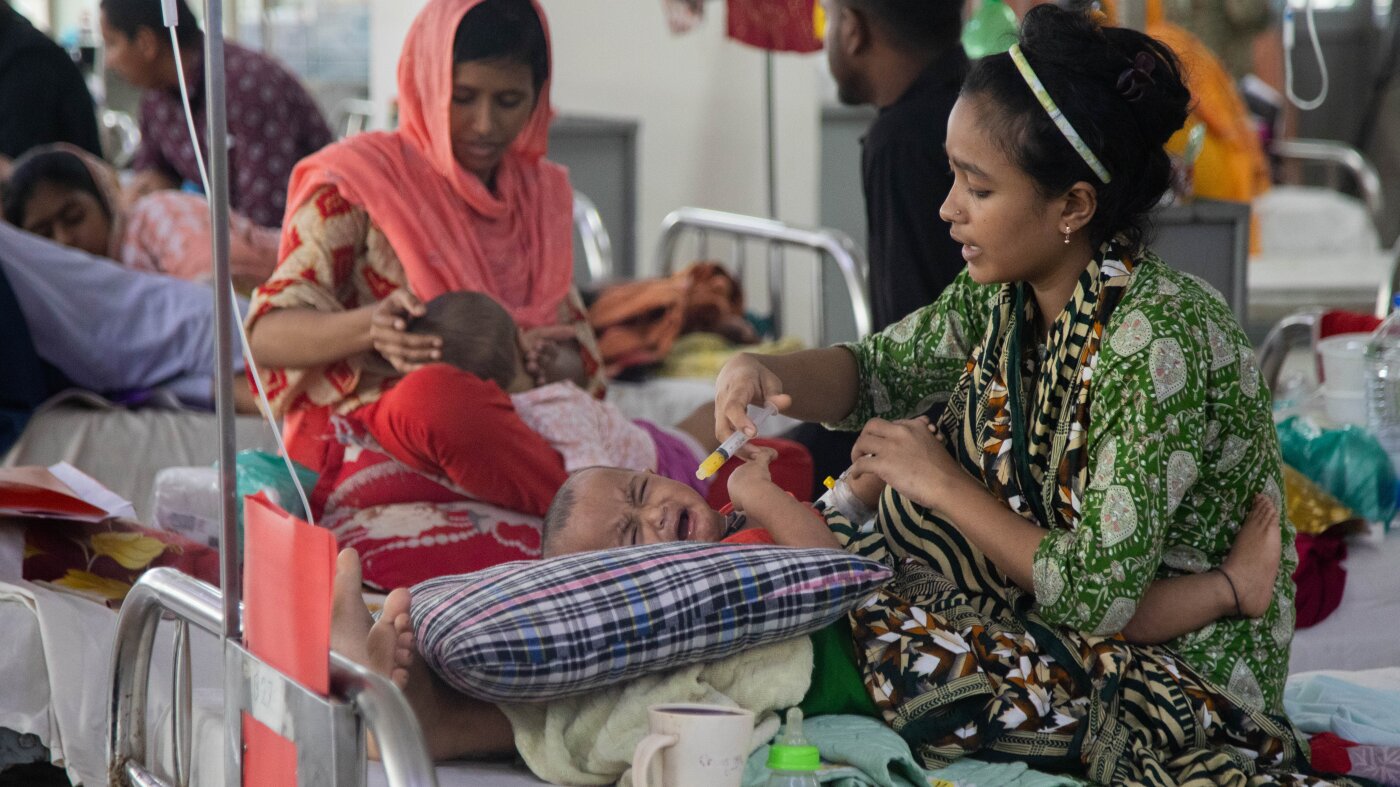
Thirteen-month-old Jannat cries as her mother Sohana, a garment worker, tries to feed her. The child is hospitalized for measles at DNCC Hospital in Dhaka, Bangladesh.
Anike Rahman for NPR
hide caption
toggle caption
Anike Rahman for NPR
Hantavirus and Ebola are making headlines. But another deadly outbreak is unfolding that’s barely registered on the global scene.
“We’ve been crying out loud about this from the beginning, but it has been a silent situation,” says Hasina Rahman. “There hasn’t been much attention around it.”
She’s talking about a devastating measles outbreak in Bangladesh.
Since the virus took off in mid-March, the country has tallied more than 60,000 suspected cases and 528 suspected measles-related deaths. The vast majority of the sick and dead are children under age 5.
“It is huge, with just so much strain on the [health care] systems,” says Rahman, who is the International Rescue Committee’s deputy regional director for Asia.
Miftahul Zannat’s family knows how strained the healthcare system is firsthand. The 2-year-old developed classic symptoms of measles — including a fever and rash — as well as vomiting and diarrhea.
After two hospital stays near their home in Bhairab, Zannat was not improving. She became lethargic and refused to eat. “Once she fell ill, she became completely bedridden. She couldn’t even open her eyes,” says her father, Mohammad Kamal.
Her worried parents, like many other families, took her to the capital, Dhaka, where hospitals have the capacity to care for patients with a severe case. The journey took several hours. But once there, the child was turned away by two facilities already overwhelmed by the crush of measles patients.
While most people who get measles recover in a few weeks, the infection can be dangerous. It can lead to complications and lasting damage, including pneumonia, inflammation of the brain and blindness. And worldwide, in 2024, nearly 100,000 people died of the disease.
Children who are malnourished are especially vulnerable to measles — and in Bangladesh, 1 in 4 children under age 5 are stunted, meaning their growth is impaired because of undernutrition, and 1 in 10 suffer from acute malnutrition. If such children do get the measles vaccine, it may be less effective. Malnutrition and undernutrition is one reason this outbreak has hit Bangladesh hard. It has contributed to the number of severe cases in Bangladesh being higher than typically seen in high-income countries — same with the death rate, which stands around 1% in Bangladesh compared to the between 0.1% and 0.3% in the U.S.
Miftahul’s father — Kamal, who works as a cook in his village — says his family has struggled in the past to provide enough food. He’s relieved they eventually found care in the third hospital they tried in Dhaka but he worries about her condition. “My child was cheerful, loved to play, run, and smile. After getting infected with measles, she became silent, not eating food, and had no smile on her face,” says Kamal..
Here is a look at what’s happening in Bangladesh: What’s behind this deadly outbreak and how the country is responding.
From vaccine success story to massive measles outbreak
Prior to this outbreak, Bangladesh was making progress toward eliminating measles with its robust, community-led vaccine program and was held up as a model for lower resource counties.
In 2019, then-Prime Minister Sheikh Hasina Wazed received The Vaccine Hero Award from Gavi, the Vaccine Alliance in recognition of the country’s “tremendous strides.”
Then came 2024.
The long-time regime was ousted and an interim government took charge. During its 18 months in power, the temporary leaders decided to revamp the vaccination system. The new plan did not go smoothly.
There were bureaucratic delays. Soon, the country’s vaccine supply was disrupted. The shots became unavailable; immunization campaigns were postponed.
This did not go unnoticed. Rana Flowers — the UNICEF representative to Bangladesh – said in a press conference on May 20 that she had repeatedly warned the government over the past two years that the delays could trigger a crisis. “I sat with the interim adviser and the staff on at least 10 occasions saying, ‘We are worried. Look at my face. I am worried. You’re going to face a mountain,’ ” recounted Flowers.
Other groups — including the World Health Organization and Gavi — also publicly urged the government last year to take action.

A pediatrician instructs a mother on how to feed her baby, who is sick with measles, to improve her nutrition and aid in recovery. The child is a patient at DNCC Hospital in Dhaka, Bangladesh, which has been overwhelmed with measles patients.
Anik Rahman for NPR
hide caption
toggle caption
Anik Rahman for NPR
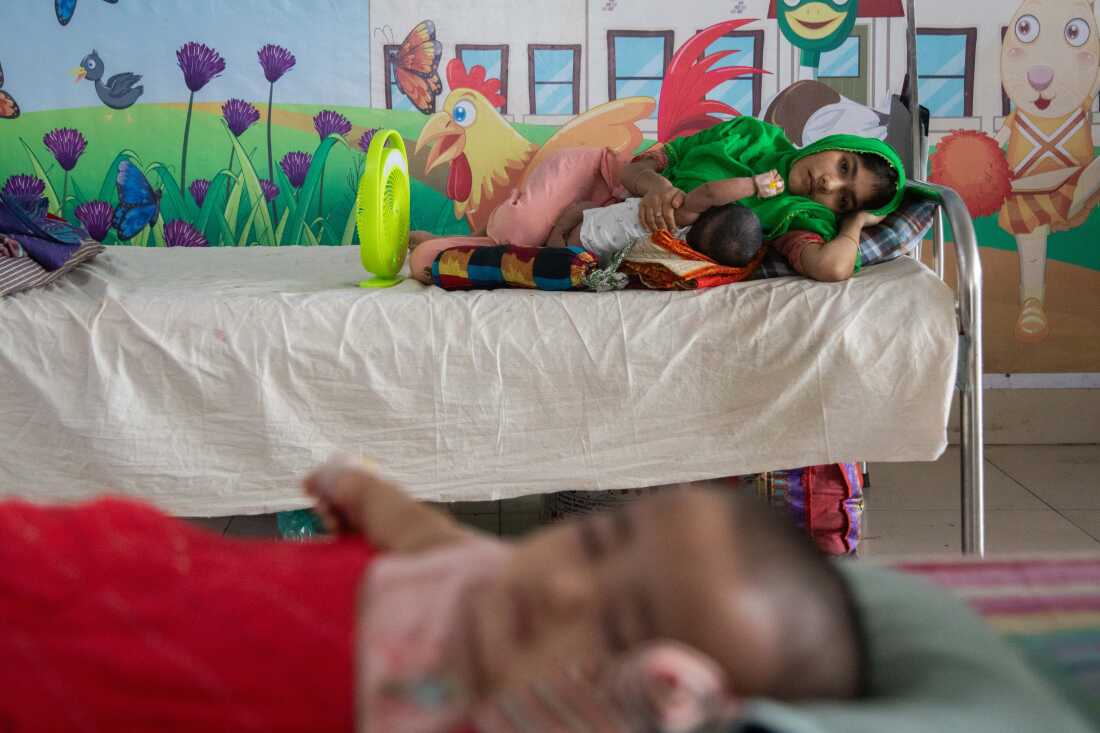
Rina cradles her 4-month-old son, Akaid, who is a measles patient at DNCC Hospital in Dhaka, Bangladesh.
Anik Rahman for NPR
hide caption
toggle caption
Anik Rahman for NPR
But nothing changed, says Dr. Reaz Mobarok, a senior professor and head of the High Dependency and Isolation Unit of the Bangladesh Shishu Hospital and Institute, the largest children’s hospital in the country: “The interim government did not bother about vaccination at all, so many children were not vaccinated for measles.”
The warnings and concerns turned out to be prescient.
Daily death counts
In early April, Bangladesh alerted WHO to a measles spike. There were close to 20,000 suspected cases in 58 of 64 districts, with over 150 deaths.
Since then, the outbreak has continued to grow.
Local news outlets now announce daily death counts — sometimes in the single digits but often higher. On one day — May 4 — 17 children died. The number of new suspected cases most days has topped 1,000 and on some days is over 1,500. As of May 24, the death count was 528.
The current measles outbreak is now the largest in Bangladesh in decades.
“This is a massive outbreak with a lot of mortality,” says Dr. William Moss, an expert in measles at the Johns Hopkins Bloomberg School of Public Health who has been tracking the situation. “It’s not surprising at all that their hospitals are overwhelmed.” He explains that, in addition to the risks associated with the measles infection, the virus weakens the immune system and patients can develop secondary infections that require medical attention.
IRC’s Rahman says the situation in Bangladesh has been compounded by the foreign aid cuts that hit global health this past year. She watched as many community health initiatives were terminated and staffing shortages exacerbated. Now she’s seeing the impact as the buckling health care system turns families away: “Parents are sitting outside the [child hospital] wards just helpless, not knowing what to do,” she says, calling the situation “heartbreaking.”
A 9-month-old’s prognosis
When Mim Akhter suspected her only child — 9-month-old Rizvi Ahmed Raihan — had developed a measles infection, she grew frightened. News stories of the mounting death toll flashed through her head. As the child struggled to breath and grew dehydrated, she took him by car three hours from their home in Manikganj district to Dhaka for medical care.
But the situation was grim at the hospital she went to. There were so many measles patients that she and her child could only get a spot on the floor with a thin mattress just in front of the elevator.
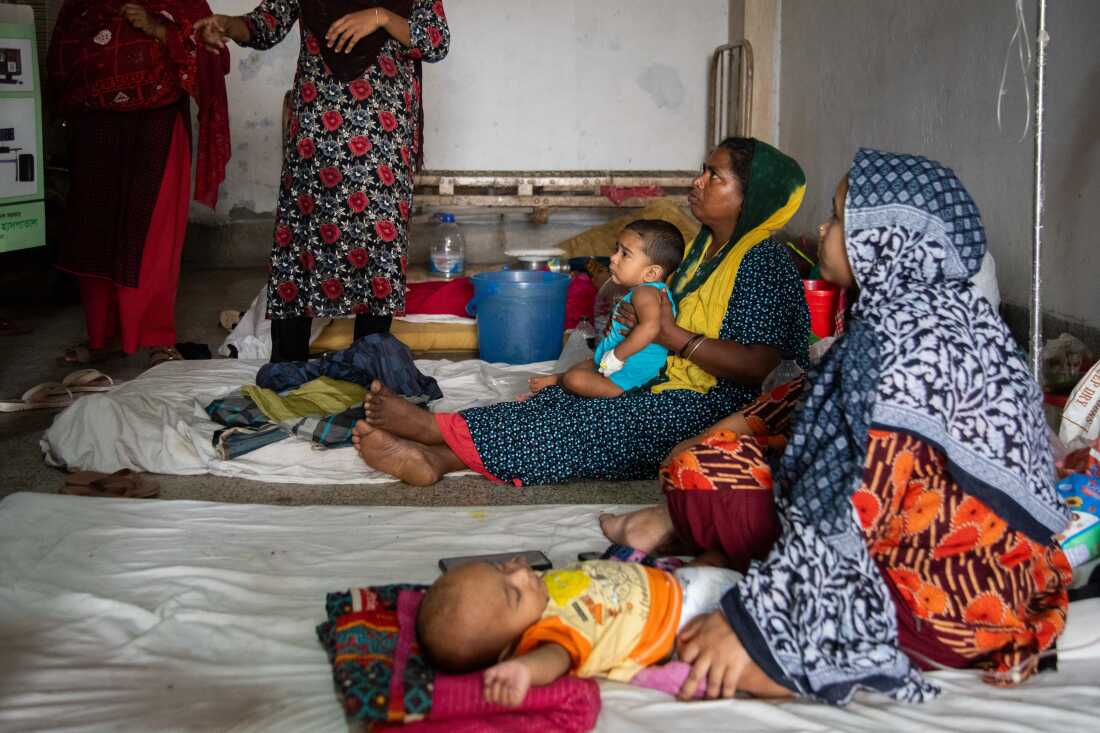
Rizvi Ahmed Raihan, a 9-month-old boy infected with measles, sits on his mother’s lap while she speaks with a pediatrician at the Infectious Disease Hospital in Dhaka, Bangladesh.
Anike Rahman for NPR
hide caption
toggle caption
Anike Rahman for NPR
“To get the treatment, we have to lie down here on the floor,” she says, speaking in Bengali. From the floor, the baby was receiving supplemental oxygen, fluids and rehydration as well as other supportive care because there’s no specific treatment for measles. After 5 days his condition improved and he was released.
Patients interviewed by NPR — as well as a report published earlier this month from the United Nations office in Bangladesh — describe not just overcrowding but inadequate medical care.
There’s short staffing. Shortages of essential medical supplies. Two measles patients often share a single Intensive Care Unit bed, sometimes with both in need of respiratory support.
And some hospitals are not able to fully isolate measles patients from other patients. For example, at the Infectious Diseases Hospital in Dhakah, HIV/AIDS patients with weakened immune systems are in the same compound — although on a different floor — than measles patients.
“My hospital has only 100 beds, and almost every day we are getting more than 100 patients,” says Dr. F. A. Asma Khan’s hospital, the Superintendent of the Infectious Diseases Hospital. She says that while not all of these patients are measles patients, many of them either have measles or a related complication.
A few miles away, Dr. Reaz Mobarok says his hospital is converting administrative rooms into patient-care rooms. “We said to the doctors: ‘You will sit in other places if you need to sit and discuss something,’ ” says Mobarok, a senior professor and head of the High Dependency and Isolation Unit of the Bangladesh Shishu Hospital and Institute, the largest children’s hospital in the country.
Desperate parents
As many parents grapple with the emotional toll of having a sick child, they’re also struggling financially. While the medical care is free in many Bangladeshi hospitals, other costs can quickly become unaffordable.
That’s what Mohammad Kamal Hossain is facing. He earns about $4 a day as a rickshaw driver in Bhola. But now that he’s spent the past 20 days caring for his 9-month-old daughter, Saifa, he’s been unable to work.
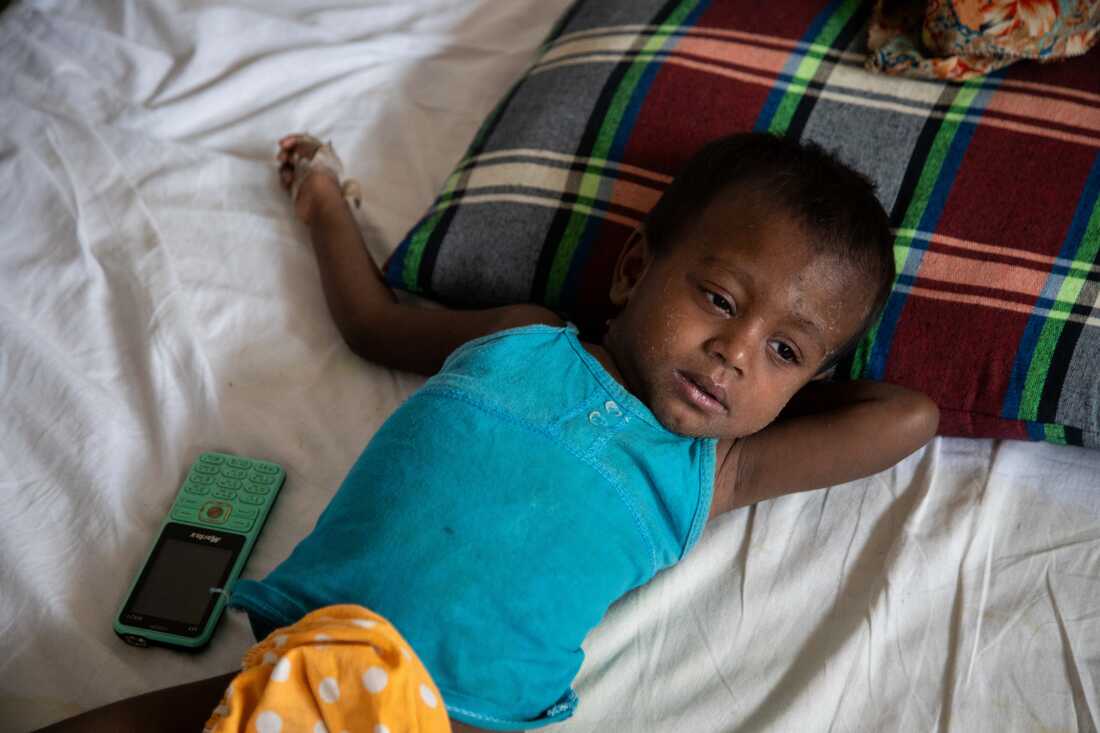
Saifa, a child infected with measles, lies on a bed after being admitted to DNCC Hospital in Dhaka, Bangladesh.
Anik Rahman for NPR
hide caption
toggle caption
Anik Rahman for NPR
After his daughter developed pneumonia, a complication commonly associated with measles, he was told to take her to Dhaka for higher level care. He says he’s already spent $160 to get to the capital and, each day, he must pay for all the expenses associated with living in the hospital, including food.
“My elder kid is studying in ninth grade and now I don’t know how I will pay her tuition fees this month because I am already in debt because of transportation costs and living in hospitals,” Hossain says.
How the government is responding
The new government of Bangladesh — elected in February — launched an enormous measles vaccination campaign on April 5.
Now, officials say, they’ve already hit their target of vaccinating approximately 18 million children. Their next priority is tracking down any children missed in the mass campaign “to ensure no child is left behind,” says Dr. Halimur Rashid, the director of disease control in the Directorate General of Health Services (DGHS) of Bangladesh.
This effort has garnered widespread praise, including from UNICEF’s Flowers. “The response was immediate. It was hard hitting from the Ministry [of Health]. For that, I am very grateful,” she says.
Rashid said his office has also been working to make sure hospitals respond appropriately. “All hospitals have been instructed to open isolation units for the measles patients, and Vitamin A capsules are being administered to affected children,” he says.
Moss, of Johns Hopkins, says this is the correct response. “Vitamin A therapy can actually significantly reduce the risk of death from measles,” he explains, noting that while vitamin A deficiency is extremely rare in the U.S. it can be common in settings like Bangladesh.
Despite the current government’s response, some parents and medical experts are frustrated. There have been calls for schools to be closed until the outbreak is under control and for the country to declare a state of health emergency.
But Moss expects things will improve. “It may take a month or more before you start really start seeing an impact [of the vaccination campaing],” he says. “But I think we should start seeing — hopefully — the case numbers go down in response to this very large measles mass vaccination campaign.”
But for some in Bangladesh, this measles outbreak is conjuring up memories from the height of the COVID pandemic — the virus killed nearly 30,000 there. But there’s a big difference between that outbreak and this measles crisis. Last time, Bangladeshis felt they were part of a global fight. This time, says Mobarok of the Bangladesh Shishu Hospital and Institute, Bangladesh feels far more alone: “We are not getting much help.”
Ali Asif Shawon is the chief reporter at Dhaka Tribune in Bangladesh, where he covers politics, security, climate change, migration and global health. He can be reached on LinkedIn.


Think about it: hantavirus and Ebola are making headlines. That speaks volumes.
If says Rahman, who is the International Rescue Committee’s deputy regional director for Asia, then the bigger picture starts to look very different.
So the bottom line is says Rahman, who is the International Rescue Committee’s deputy regional director for Asia. Wonder how this will land.
If miftahul Zannat’s family knows how strained the healthcare system is firsthand, then the bigger picture starts to look very different.
Still waiting to hear what Hasina Rahman actually plans to do about it.
In other words thirteen-month-old Jannat cries as her mother Sohana, a garment worker, tries to feed her. Curious to see how this develops.
In other words hantavirus and Ebola are making headlines. Curious to see how this develops.
Considering since the virus took off in mid-March, the country has tallied more than 60,000 suspected cases and 528 suspected measles-related deaths, it raises some real questions about what happens next.
On one hand hantavirus and Ebola are making headlines. But at the same time since the virus took off in mid-March, the country has tallied more than 60,000 suspected cases and 528 suspected measles-related deaths.
What stands out is says Rahman, who is the International Rescue Committee’s deputy regional director for Asia. That is the part worth paying attention to.
Reading that since the virus took off in mid-March, the country has tallied more than 60,000 suspected cases and 528 suspected measles-related deaths — hard to argue with the logic there.
The bigger issue here is says Rahman, who is the International Rescue Committee’s deputy regional director for Asia. That changes the calculation.
The bigger issue here is hantavirus and Ebola are making headlines. That changes the calculation.
If since the virus took off in mid-March, the country has tallied more than 60,000 suspected cases and 528 suspected measles-related deaths, then the bigger picture starts to look very different.
When you look at says Rahman, who is the International Rescue Committee’s deputy regional director for Asia, the implications are hard to ignore.