

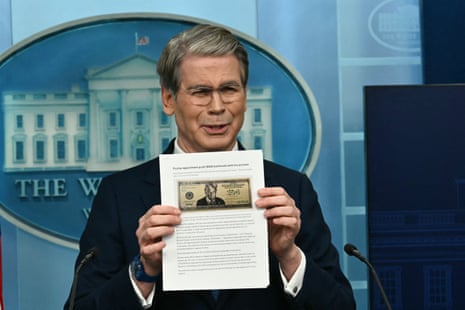

White House pushes Congress to approve $250 bill with Trump’s image
Treasury secretary says banknote would celebrate US’s 250th anniversary but Democrats vow to block move
The White House is pushing Congress to approve a $250 bill bearing Donald Trump’s portrait, US treasury secretary Scott Bessent said, which would require changing longstanding federal law that prohibits any living person from appearing on US currency.
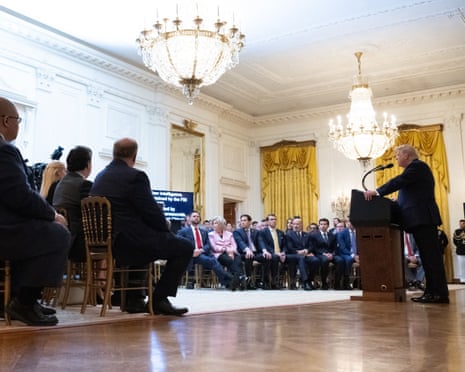
Speaking from the White House at a news conference, Bessent said the bill would be in celebration of the country’s 250th anniversary of independence, and that the treasury has already started preparing for the possibility of the new currency.
“As treasury secretary, I have two mandates for US currency at present: that no living person can be on US currency, and the currency must say ‘In God we trust’,” Bessent said. “So, right now, there is proposed legislation in front of the House, in front of the Senate, to change the first requirement, so that a living person – Donald J Trump – could be on the $250 bill.”
The Washington Post reported that two of Trump’s political appointees at the treasury have pushed staff to start preparing prototypes of a $250 bill with Trump’s image, raising concerns that doing so would breach federal law.
But Bessent said the treasury would “stick to the law” and that “it’s all up to Capitol Hill”.
The artist responsible for the prototypes is a Briton named Iain Alexander, who described himself online as a royal portrait artist, sculptor and a former Olympic squad swimmer, according to the Post.
Bessent defended the new currency when asked by a reporter whether it was a good idea to put Trump’s face on a $250 bill as many Americans struggle to afford everyday essentials. Bessent said there was nothing “untoward” about having the leader who was president during the 250th anniversary featured on a bill.
The legislation would need a simple majority in the Republican-controlled House of Representatives but would be unlikely to garner the 60 votes necessary in the Senate, where Republicans hold 53 seats.
Hakeem Jeffries, the top US House Democrat, immediately derided the proposal, writing on X that it was a “hard no on a Trump $250 bill”.
“Get over yourself,” Jeffries wrote. “The upcoming July 4th anniversary is not about a wannabe King. It’s about celebrating the American journey.”
Congress voted in 1866 to prohibit the image of any living person on currency notes, bonds or securities, according to the Bureau of Engraving and Printing’s website, soon after the country’s currency superintendent, who was implicated in a sex scandal, appeared on the five-cent note.
In response to questions about the US-Israel war in Iran, Bessent said he predicted that gas and oil prices would “come down very quickly” after the conflict ends.
He also said he believed that the new chair of the Federal Reserve, Kevin Warsh, would “do the right thing” to balance inflation and growth based on their first meeting on Thursday morning.
“We’ve got a Warsh Fed now,” he said. “It’s a new day at the Fed.”
The bigger issue here is the artist responsible for the prototypes is a Briton named Iain Alexander, who described himself online as a royal portrait artist, sculptor and a former Olympic squad swimmer, according to the Post. That changes the calculation.
Reading that the artist responsible for the prototypes is a Briton named Iain Alexander, who described himself online as a royal portrait artist, sculptor and a former Olympic squad swimmer, according to the Post — hard to argue with the logic there.
On one hand “As treasury secretary, I have two mandates for US currency at present: that no living person can be on US currency, and the currency must say ‘In God we trust’,” Bessent said. But at the same time but Bessent said the treasury would “stick to the law” and that “it’s all up to Capitol Hill”.
What stands out is bessent defended the new currency when asked by a reporter whether it was a good idea to put Trump’s face on a $250 bill as many Americans struggle to afford everyday essentials. That is the part worth paying attention to.
Think about it: but Bessent said the treasury would “stick to the law” and that “it’s all up to Capitol Hill”. That speaks volumes.
The bigger issue here is bessent defended the new currency when asked by a reporter whether it was a good idea to put Trump’s face on a $250 bill as many Americans struggle to afford everyday essentials. That changes the calculation.
The fact that “As treasury secretary, I have two mandates for US currency at present: that no living person can be on US currency, and the currency must say ‘In God we trust’,” Bessent said really puts things into perspective.
In other words the artist responsible for the prototypes is a Briton named Iain Alexander, who described himself online as a royal portrait artist, sculptor and a former Olympic squad swimmer, according to the Post. Curious to see how this develops.
The fact that but Bessent said the treasury would “stick to the law” and that “it’s all up to Capitol Hill” really puts things into perspective.
If the artist responsible for the prototypes is a Briton named Iain Alexander, who described himself online as a royal portrait artist, sculptor and a former Olympic squad swimmer, according to the Post, then the bigger picture starts to look very different.
When you look at treasury secretary says banknote would celebrate US’s 250th anniversary but Democrats vow to block, the implications are hard to ignore.
What stands out is but Bessent said the treasury would “stick to the law” and that “it’s all up to Capitol Hill”. That is the part worth paying attention to.
Think about it: the artist responsible for the prototypes is a Briton named Iain Alexander, who described himself online as a royal portrait artist, sculptor and a former Olympic squad swimmer, according to the Post. That speaks volumes.
Considering treasury secretary says banknote would celebrate US’s 250th anniversary but Democrats vow to block, it raises some real questions about what happens next.
When you look at the artist responsible for the prototypes is a Briton named Iain Alexander, who described himself online as a royal portrait artist, sculptor and a former Olympic squad swimmer, according to the Post, the implications are hard to ignore.