
Asia defense summit opens amid doubts over U.S. priorities

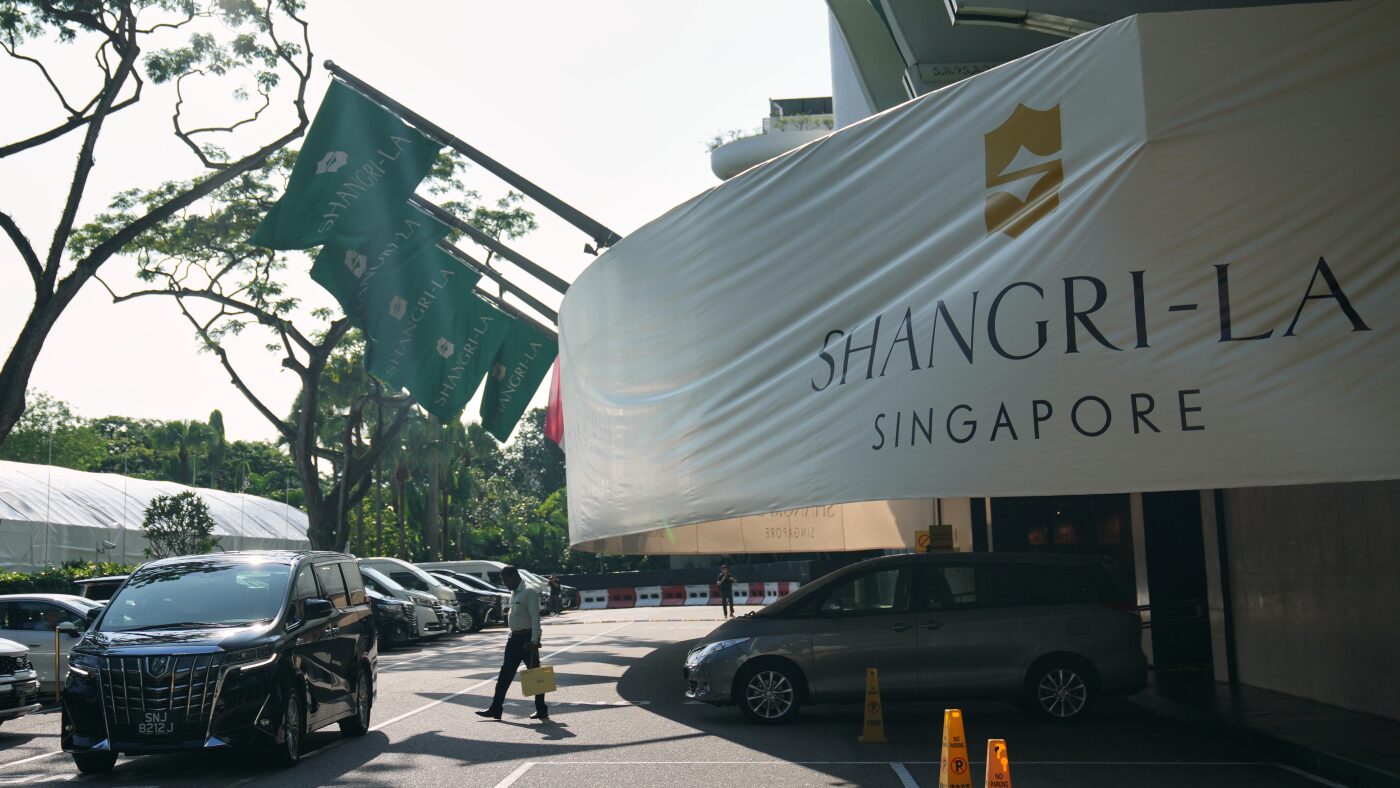
A man walk near the entrance of the Shangri-La Hotel, the venue for the International Institute for Strategic Studies (IISS) Shangri-La Dialogue, Asia’s annual defense and security forum, in Singapore, Thursday, May 28, 2026.
Achmad Ibrahim/AP
hide caption
toggle caption
Achmad Ibrahim/AP
SINGAPORE — China’s rapid military modernization and assertiveness in the Indo-Pacific and growing concerns over American priorities are top issues on the table at Asia’s premier defense summit drawing leaders, top diplomats and security officials from around the world.
The Shangri-La Dialogue, hosted by the International Institute for Strategic Studies, also comes as the Middle East is increasingly on edge as new attacks have threatened the tenuous ceasefire in the Iran war. Russia, meanwhile, has intensified its war on Ukraine.
Vietnamese leader To Lam opens the conference Friday with a keynote address, while U.S. Defense Secretary Pete Hegseth starts Saturday’s session with remarks focused on the Trump administration’s Indo-Pacific strategy.
Vietnam navigates a delicate superpower balance
Lam has consolidated his power in Vietnam this year, becoming both Communist Party general secretary and president of the strategically important Southeast Asian nation, departing from its tradition of shared leadership.
Like several other countries in the region, Vietnam has competing maritime claims with Beijing that have led to confrontations, but at the same time is heavily tied economically to China, its biggest two-way trade partner.
The U.S., meantime, is Vietnam’s largest export destination and has been seeking to make diplomatic inroads and expand defense contracts to try and pull some of that market away from Hanoi’s traditional partner, Russia.
Recently leaked documents showed, however, that even after elevating relations with Washington to the highest diplomatic level, Vietnam’s military remained skeptical of American intentions and had taken steps to defend against a possible American “war of aggression.”
With Hanoi performing a delicate balancing act with both Washington and Beijing, Lam was expected to keep his address focused on using consensus to manage differences and working jointly on regional stability and development.
Lam was expected to meet on the sidelines of the conference with Hegseth, who will be making his second appearance at the event. Last year in Singapore, Hegseth raised the ire of Beijing by saying ” the threat China poses is real, and it could be imminent,” and that its military was “rehearsing for the real deal.”
Hegseth said Washington would bolster its defenses to counter what the Pentagon sees as rapidly developing threats, particularly in China’s aggressive stance toward Taiwan.

FILE – U.S. Defense Secretary Pete Hegseth, left, and General Secretary of Vietnam’s Communist Party To Lam shake hands in Hanoi, Vietnam, Nov. 2, 2025.
Hau Dinh/AP
hide caption
toggle caption
Hau Dinh/AP
Questions about US commitments
But this year’s speech comes only about two weeks after U.S. President Donald Trump visited Chinese leader Xi Jinping in Beijing, where Xi warned that their two countries could clash over Taiwan if the issue was not handled properly.
Following the meetings, Trump called Xi a “great leader” and said that they were going to have a “fantastic future together.” Trump also raised questions about Washington’s willingness to defend Taiwan, calling a new $14 billion arms package that he has yet to greenlight “a very good negotiating chip for us” with China.
China claims the self-governing democratic island as its own, and Xi has not ruled out using force to take it.
The U.S., meantime, supplies Taiwan with modern aircraft, missiles and other weapons to help it defend itself, though follows a policy of “strategic ambiguity” on whether it would intervene militarily if China were to attack the island.
Trump has shown greater ambivalence toward Taiwan than his predecessors, fueling speculation about whether the president could be persuaded to dial back American support.
Hegseth’s speech will focus on the military’s “common-sense approach to safeguarding U.S. vital national interests in the Indo-Pacific,” according to the Pentagon.
Coming so soon after the meeting of the two leaders in Beijing, it seems unlikely Hegseth will say anything to upstage Trump’s own remarks.
China is due to open Sunday’s dialogue with its view, though Beijing was only sending a lower-level delegation this year, according to Chinese media reports. It was not immediately clear who would be speaking.
Chinese Defense Minister Dong Jun also did not attend last year’s event.
Ukraine and the Middle East are unavoidable topics
While the annual conference tilts toward Asian security issues, there will be no avoiding Russia’s ongoing war against Ukraine and the Iran war, which has led to the shutdown of the Strait of Hormuz.
In peacetime, a fifth of the world’s oil is shipped through the strait, and since it has been effectively closed by Iran, global oil prices have spiked, causing economic problems around the world. Qatar’s minister of defense is among the speakers this weekend.
Just ahead of the conference, Ukrainian President Volodymyr Zelenskyy wrote to Trump and U.S. Congress asking for more American-made air defense ammunition to counter intensifying Russian ballistic missile attacks.
Though Zelenskyy, who made a surprise in-person appearance at Shangri-La two years ago, is not expected this year, speakers will include many top European defense officials, including from Lithuania and Poland.
Reading that vietnamese leader To Lam opens the conference Friday with a keynote address, while U.S — hard to argue with the logic there.
Think about it: recently leaked documents showed, however, that even after elevating relations with Washington to the highest diplomatic level, Vietnam’s military. That speaks volumes.
Think about it: washington would bolster its defenses to counter what the Pentagon sees as rapidly developing threats, particularly in China’s aggressive stance toward Taiwan. That speaks volumes.
What stands out is recently leaked documents showed, however, that even after elevating relations with Washington to the highest diplomatic level, Vietnam’s military. That is the part worth paying attention to.
On one hand washington would bolster its defenses to counter what the Pentagon sees as rapidly developing threats, particularly in China’s aggressive stance toward Taiwan. But at the same time fILE – U.S. Defense Secretary Pete Hegseth, left, and General Secretary of Vietnam’s Communist Party To Lam shake hands in Hanoi, Vietnam, Nov.
When you look at washington would bolster its defenses to counter what the Pentagon sees as rapidly developing threats, particularly in China’s aggressive stance toward Taiwan, the implications are hard to ignore.
Reading that recently leaked documents showed, however, that even after elevating relations with Washington to the highest diplomatic level, Vietnam’s military — hard to argue with the logic there.
The detail about vietnamese leader To Lam opens the conference Friday with a keynote address, while U.S is something people should sit with.
The detail about lam was expected to meet on the sidelines of the conference with Hegseth, who will be making his second appearance at the event is something people should sit with.
The fact that fILE – U.S. Defense Secretary Pete Hegseth, left, and General Secretary of Vietnam’s Communist Party To Lam shake hands in Hanoi, Vietnam, Nov really puts things into perspective.
In other words recently leaked documents showed, however, that even after elevating relations with Washington to the highest diplomatic level, Vietnam’s military. Curious to see how this develops.
The bigger issue here is recently leaked documents showed, however, that even after elevating relations with Washington to the highest diplomatic level, Vietnam’s military. That changes the calculation.
Achmad Ibrahim has been pushing this agenda for a while now.
Achmad Ibrahim has been vocal about this, good to see them staying on it.
Basically recently leaked documents showed, however, that even after elevating relations with Washington to the highest diplomatic level, Vietnam’s military. What matters is whether anything changes because of it.