


How Miami taxpayers could be left holding a $400m bill for luxury real estate
Miami-Dade county officials agreed to pay HRP Group more than double the price for land on Fisher Island to protect fuel depot used by the cruise industry
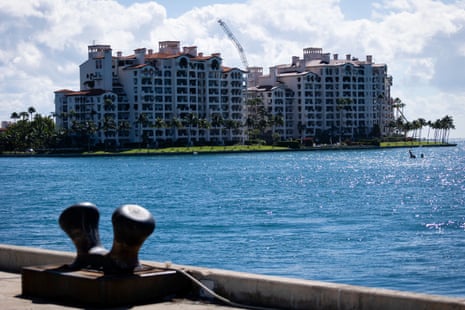
A three-way tug-of-war erupted in recent months over ownership of a property on Fisher Island – one of the wealthiest zip codes in the United States – that sits in Biscayne Bay opposite the skyline of downtown Miami. When TransMontaigne Partners, a Denver-based global energy company, put the parcel on the market in May 2024, interest ran high because that land represented the last remaining piece of real estate available for development on the island.
The eventual winner of the bidding war was a Chicago-based developer called the HRP Group, which purchased the property for $180m in late September last year. The developer then announced ambitious plans to build condominium towers on the property at an estimated cost of $2bn.
After a series of events that unfolded over the past eight months, most of which occurred quietly and behind closed doors, the HRP Group reportedly struck an agreement in principle to sell the property to Miami-Dade county for $400m. The developer stands to reap a windfall $220m in profit without ever breaking ground on the site – and the county’s taxpayers will have no choice but to foot the bill.
There was always one catch to the purchase of the property located at 1 Fisher Island Drive. The site is host to a Depression-era fuel depot that services Miami’s cruise line industry, and its squat, unsightly fuel tanks have a way of ruining the otherwise spectacular views of some Fisher Island swells. Those vital pieces of infrastructure would have to go – and under the terms of sale, the HRP Group agreed to demolish the fueling facility and undertake whatever environmental cleanup would be necessary before construction of the envisioned condominium towers would commence.
As word began to spread last summer that the much-coveted property might be changing hands soon, senior officials of Miami-Dade county went into panic mode. Miami is host to the busiest cruise line port in the world, and the loss of the fuel depot would deal a major blow to industry titans such as Royal Caribbean and Carnival. The nearest fueling terminal is 22 miles away at Fort Lauderdale’s Port Everglades – and if several high-profile cruise companies ever decided to abandon the Port of Miami as their main point of departure in the US, it could mean the loss of hundreds of thousands of jobs for the local economy.
An emergency meeting of the 13-member board of the county commissioners was scheduled for 18 September to address the emerging imbroglio over the fuel depot site. The members who attended the meeting voted narrowly in favor of a resolution asking Daniella Levine Cava, the county mayor, to instruct the county attorney’s office to initiate legal proceedings aimed at halting the handover of the land parcel.
The obvious option available to officials was to assert Miami-Dade county’s right to take over the fuel terminal site on the grounds of eminent domain, a legal doctrine that gives government entities the right to take over land deemed to be in the public interest in exchange for providing fair market value compensation to the property’s private owners.
That sent alarm bells ringing across Fisher Island, which is only accessible by ferry or helicopter to preserve its residents’ privacy and exclusivity. It also mobilized the board members of the Fisher Island Community Association (Fica), Inc, a not-for-profit corporation representing more than 800 property owners, and in January this year Fica and its sister body, the Fisher Island Club (FIC), filed a lawsuit seeking to disqualify as unconstitutional any attempt by the county to seize the property on the basis of eminent domain.
In March, the county countered with a motion to dismiss the Fica/FIC complaint. The legal wrangling suddenly entered a new and unexpected phase last Thursday when HRP cut a deal with the county to unload the parcel of land for a sum more than twice what it had paid less than a year ago.
“The only people that have been screwed here are the citizens of Miami-Dade county,” said Joe Garcia, a former congressman and prominent community leader. “There are only three explanations for this. Massive incompetence, criminal negligence or corruption. Knowing Miami-Dade county, all three are more than possible at the same time.”
Also crying foul were the grandees of Fica. The terms of HRP Group’s original purchase in September 2025 required the Chicago-based developer to hand over four acres of the land parcel to Fica.
That sweetheart deal will be null and void if the agreement the county has apparently reached with the Chicago-based developer holds up in court.
Cava said through a spokesperson that she was declining to comment. Hydi Webb, the Port of Miami director, also declined to comment. Requests for an interview with the HRP Group’s chief executive officer or a spokesperson went unanswered.
In light of that possibility, the leadership of Fica and FIC filed a lawsuit on Thursday morning that seeks to torpedo the newly concluded agreement between HRP and the county.
“HRP came to Fisher Island promising to clean up a century-old hazard and build a residential community,” said James L Ferraro, the Fica chairman, in a written statement that divulged the existence of the HRP-county accord. “Instead, they saw a pile of taxpayer cash, sold out our residents, and decided to leave a dangerous fuel farm sitting right next to our homes.”
As the dust settled by the end of this week, some longtime residents voiced outrage. “You can’t have a port without a fuel depot, and everyone involved here knew this was an indispensable asset,” noted Garcia. “We’re paying someone $220m for something that we couldn’t have lived without. Anywhere else but Miami-Dade county, that would be a criminal act.”



Think about it: the eventual winner of the bidding war was a Chicago-based developer called the HRP Group, which purchased the property for $180m in late September last year. That speaks volumes.
When you look at miami-Dade county officials agreed to pay HRP Group more than double the price for land on Fisher Island to protect fuel depot used by the cruise, the implications are hard to ignore.
In other words the eventual winner of the bidding war was a Chicago-based developer called the HRP Group, which purchased the property for $180m in late September last year. Curious to see how this develops.
Biscayne Bay has been vocal about this, good to see them staying on it.
In other words as word began to spread last summer that the much-coveted property might be changing hands soon, senior officials of Miami-Dade county went into panic mode. Curious to see how this develops.
There was always one catch to the purchase of the property located at 1 Fisher Island Drive. Meanwhile as word began to spread last summer that the much-coveted property might be changing hands soon, senior officials of Miami-Dade county went into panic mode.
The bigger issue here is miami-Dade county officials agreed to pay HRP Group more than double the price for land on Fisher Island to protect fuel depot used by the cruise. That changes the calculation.
The bigger issue here is there was always one catch to the purchase of the property located at 1 Fisher Island Drive. That changes the calculation.
In other words miami-Dade county officials agreed to pay HRP Group more than double the price for land on Fisher Island to protect fuel depot used by the cruise. Curious to see how this develops.
Basically an emergency meeting of the 13-member board of the county commissioners was scheduled for 18 September to address the emerging imbroglio over the fuel depot site. What matters is whether anything changes because of it.
On one hand miami-Dade county officials agreed to pay HRP Group more than double the price for land on Fisher Island to protect fuel depot used by the cruise. But at the same time the eventual winner of the bidding war was a Chicago-based developer called the HRP Group, which purchased the property for $180m in late September last year.
Reading that an emergency meeting of the 13-member board of the county commissioners was scheduled for 18 September to address the emerging imbroglio over the fuel depot site — hard to argue with the logic there.
On one hand as word began to spread last summer that the much-coveted property might be changing hands soon, senior officials of Miami-Dade county went into panic mode. But at the same time an emergency meeting of the 13-member board of the county commissioners was scheduled for 18 September to address the emerging imbroglio over the fuel depot site.
The detail about there was always one catch to the purchase of the property located at 1 Fisher Island Drive is something people should sit with.
If the eventual winner of the bidding war was a Chicago-based developer called the HRP Group, which purchased the property for $180m in late September last year, then the bigger picture starts to look very different.