


California’s proposed billionaire tax: what you need to know
Plan to levy 5% tax on California billionaires championed by progressives – but state’s super rich are forcefully opposed
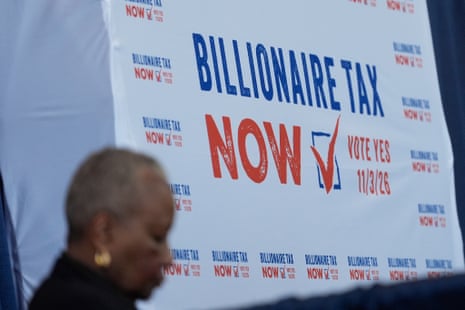
The proposed billionaire tax in California is officially heading to voters’ ballots in November. After getting more than double the necessary signatures to qualify, the secretary of state certified the ballot measure late on Thursday.
The confirmation came after backroom dealing didn’t pan out between California’s governor, Gavin Newsom, who opposes the proposal, and the labor union backing it.
While the wealth tax would only apply to individual billionaires living in California, the idea of passing a tax on the ultra-rich has become a national issue. Prominent political figures on the left, such as the Vermont senator Bernie Sanders, have championed the state measure, saying it could pave the way for a similar tax on the federal level.
“Never before have so few people had so much wealth and so much power,” Sanders said during a February speech supporting the initiative in Los Angeles. “These billionaires are going to learn that we are still living in a democratic society where the people have some power.”
But the measure’s backers are going to have to contend with powerful opponents to the initiative, including Newsom and Silicon Valley billionaires. The tech and crypto industry are throwing in tens of millions of dollars – in what’s expected to add up to unprecedented campaign spending – to oppose the initiative.
So that means a messy fight is about to get a lot messier.
What would the billionaire tax do?
The California Billionaire Tax Act would levy a one-time 5% tax on any California resident worth more than $1bn. The proposal is backed by the Service Employees International Union-United Healthcare Workers West (SEIU-UHW) as a means of funding California’s strainedfood-assistance, education and healthcare programs, including safeguarding low-cost health coverage and preventing widespread hospital and emergency room closures.
“Regular working people pay higher effective tax rates than the wealthiest Americans,” Suzanne Jimenez, the chief of staff for SEIU-UHW, earlier told the Guardian in an email. “Asking those who have benefited most from the economy to contribute more – particularly to stabilize health care systems under direct threat – is a reasonable step.”
Jimenez said the initiative is a direct response to federal healthcare cuts under Donald Trump’s One Big Beautiful Bill Act.
The tax would apply retroactively to all billionaires who were California residents as of 1 January 2026. The state is home to more billionaires than any other – approximately 200 – many of whom have increased their wealth in the recent AI boom.
Who opposes the billionaire tax and why?
While several local unions and lawmakers, including California congressman Ro Khanna, have joined the coalition to support the billionaire tax, powerful organizations in the state have also stepped in to oppose it. Those include other labor unions, like the California Teachers Association and the State Building and Construction Trades Council of California, along with healthcare groups, including the California Medical Association and Planned Parenthood Affiliates of California.
These groups say the ballot measure does not have a long-term funding path and has no guarantees that the one-time lump sum will go to those who need it most. A spokesperson for Planned Parenthood Affiliates of California told the Guardian that the group “agrees the wealthy must pay their fair share”, but that the measure is “short-sighted” and “does not offer a sustainable solution to funding cuts”.
Newsom has been one of the most vocal opponents, vowing from the beginning to quash the initiative. He has said such state-level wealth taxes “drive a race to the bottom” and that the measure would chase billionaires out of California and strip the state of revenue.
Over the last week, Newsom had reportedly whipped together a coalition to help him negotiate a deal with the union to withdraw the measure before Thursday’s certification deadline. Despite the SEIU-UHW offering a concession to drop the one-off tax from 5% to 2%, the governor did not accept the watered-down proposal.
What about the tech billionaires?
No industry has come out harder to fight the billionaire tax than the tech industry. From the first days of signature gathering for the ballot measure late last year, Silicon Valley billionaires have been pouring enormous sums of money into super political action committees (Super Pacs) to battle the initiative.
The biggest spenders have been Google co-founder Sergey Brin, who’s worth around $260bn and has so far spent at least $82m to oppose the tax, and crypto billionaire Chris Larsen, who’s worth more than $11bn and has contributed at least $13.2m to fight the measure, according to campaign finance filings.
Dozens of other Silicon Valley luminaries have also donated millions, including Palantir co-founder Peter Thiel, former Google CEO Eric Schmidt, DoorDash CEO Tony Xu, Stripe CEO Patrick Collison and several prominent venture capitalists.
This spending has paid off. Within the last couple of days, the tech billionaires have been able to get two of their own initiatives – designed to oppose the wealth tax – on the November ballot. One measure would prohibit new taxes on individually-owned assets and savings and bar California from retroactively imposing taxes. The other measure would require audits of any state programs that received funding from a voter initiative and prohibit any new state taxes enacted after 1 January 2026.
What this means is California’s November ballot is going to have three measures aimed at taxation and will likely result in voter confusion. Election watchers anticipate Silicon Valley to step up its spending and that the next few months will see a flurry of activity with the state’s residents being bombarded with mailers, robo-calls and ad campaigns about the billionaire tax.
“What you’re seeing now … it was just like a drop in the bucket of what’s going to happen,” said Francesco Trebbi, a public policy professor at the University of California in Berkeley. “It’s going to be exponential.”
About the Author





The fact that “Never before have so few people had so much wealth and so much power,” Sanders said during a February speech supporting the initiative in Los Angeles really puts things into perspective.
Think about it: “Never before have so few people had so much wealth and so much power,” Sanders said during a February speech supporting the initiative in Los Angeles. That speaks volumes.
The bigger issue here is the proposed billionaire tax in California is officially heading to voters’ ballots in November. That changes the calculation.
The detail about the confirmation came after backroom dealing didn’t pan out between California’s governor, Gavin Newsom, who opposes the proposal, and the labor union backing it is something people should sit with.
So the bottom line is plan to levy 5% tax on California billionaires championed by progressives – but state’s super rich are forcefully. Wonder how this will land.
In other words “Never before have so few people had so much wealth and so much power,” Sanders said during a February speech supporting the initiative in Los Angeles. Curious to see how this develops.
Plan to levy 5% tax on California billionaires championed by progressives – but state’s super rich are forcefully. Meanwhile the proposed billionaire tax in California is officially heading to voters’ ballots in November.
Considering while the wealth tax would only apply to individual billionaires living in California, the idea of passing a tax on the ultra-rich has become a national issue, it raises some real questions about what happens next.
While the wealth tax would only apply to individual billionaires living in California, the idea of passing a tax on the ultra-rich has become a national issue. Meanwhile “Never before have so few people had so much wealth and so much power,” Sanders said during a February speech supporting the initiative in Los Angeles.
Think about it: the proposed billionaire tax in California is officially heading to voters’ ballots in November. That speaks volumes.
When you look at plan to levy 5% tax on California billionaires championed by progressives – but state’s super rich are forcefully, the implications are hard to ignore.
The bigger issue here is plan to levy 5% tax on California billionaires championed by progressives – but state’s super rich are forcefully. That changes the calculation.
The detail about the proposed billionaire tax in California is officially heading to voters’ ballots in November is something people should sit with.
On one hand the proposed billionaire tax in California is officially heading to voters’ ballots in November. But at the same time the confirmation came after backroom dealing didn’t pan out between California’s governor, Gavin Newsom, who opposes the proposal, and the labor union backing it.