


Trump’s midterm malaise: endless war and high prices could spell doom for Republicans in November
‘Complete unraveling’ of Trump and Republican project reflects attitude of not caring at all about governance
He was always one step ahead. Donald Trump won the US presidency as a wildly unlikely outsider in 2016 and staged an astonishing comeback to win it again in 2024. Even his foes grudgingly called him a political savant with an intuition for exploiting grievances that left so-called experts floundering.
But now they are asking if the dark genius has lost his touch. Trump is trapped in the quagmire of an unpopular war, obsessing over monuments in Washington and looking for a new spokesperson after his White House press secretary quit. If the 80-year-old was deliberately trying to sabotage his Republican party in November’s midterm elections, it is not clear what he would do differently.
“He’s always had a reptilian political instinct for public opinion that has served him well,” said Charlie Sykes, a conservative author and broadcaster. “You’re not seeing that much any more. You’re not seeing his ability to read the room. He seems tone-deaf on issues like the cost of living, the war, and the optics of gilding everything in sight and enshittifying Washington and he doesn’t care.”
Trump campaigned on promises to lower prices and keep the US out of foreign entanglements and forever wars. The opposite has happened. Voters say they are suffering a cost of living crisis, exacerbated by Trump’s sweeping tariffs. Buying food to eat at home has become 33% more expensive in US cities since the beginning of 2019, according to government figures.
Gas prices are at a record high for this time of year, in part thanks to the US war in Iran, which drags on with no end in sight. While Trump claims to have destroyed Iran’s military capabilities, it emerged this week that he was forced to hide in a catering truck and secretly swap planes after a Nato summit in Turkey because of a possible Iranian assassination plot.
The administration’s entanglement has metastasised into a gruelling, daily haemorrhage of resources, currently costing the taxpayer an estimated $1bn a day. Critics argue the administration has strengthened Iran’s resolve and provided it with global leverage, specifically over the strait of Hormuz. They see it as betrayal of the noninterventionist posture that fuelled Trump’s rise to power and attracted a generation of disaffected voters.
Kurt Bardella, a political commentator and former congressional aide, said: “What we’re watching right now is the complete unraveling of everything that Donald Trump, Maga and Republicans said they were about. They were against endless conflicts in the Middle East and they started a conflict in the Middle East without an exit strategy.They were supposed to be about no more spending American dollars abroad; we’re spending a billion dollars a day on this war without an end.”
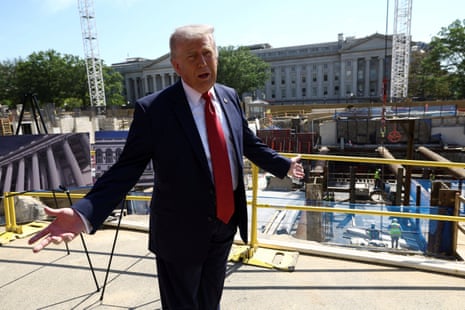
Yet the president appears to have other, more aesthetic concerns. Since returning to power last year, the longtime property developer has invested much time and energy in construction projects across Washington, including a White House ballroom and helipad, a triumphal arch and an ill-fated makeover of the Lincoln Memorial reflecting pool.
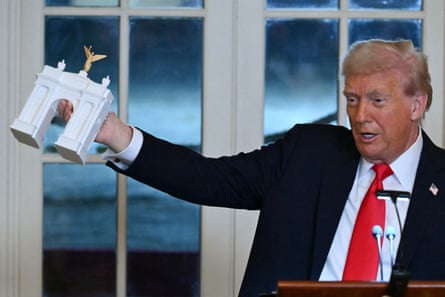
Bardella added: “As he continues this misadventure in the Middle East that has resulted in the cost of living going up, and continues to pour resources into putting his name on shit and building ballrooms and monuments to himself, the American people are going: what the fuck? That’s the only realistic reaction you could have when you objectively look at the circumstances.”
Trump’s second term has been defined by thinking big – Greenland, Venezuela, Iran – and thinking small. The board he appointed to the John F Kennedy Center for the Performing Arts added his name to the complex, only for a judge to order that it be removed; this week the board voted to add “Restored and Renovated by President Donald J Trump” beneath the main sign.
According to Regime Change: Inside the Imperial Presidency of Donald Trump, written by New York Times journalists Maggie Haberman and Jonathan Swan, the president has been seen with a tube of super glue trying to stick golden decorations to the marble fireplace in the Oval Office.
Haberman estimates that Trump now devotes 70% of his mental space to renovation projects and “monuments to self”. She told Axios’s Behind the Curtain video series that she and Swan visited Trump in the Oval Office in March. “You would think that on the 17th day of the war that he would have maps of the Middle East or maps of troop deployments – who knows,” she said. “He picks up these pictures, and [they’re] of maple trees, and he says: ‘I am choosing maple trees for the White House. I am good at picking trees.’ I’m paraphrasing here, but that is pretty much what he said.”
The president’s preoccupation with whether columns for his ballroom are more evocative of Athens or Rome, and with other efforts to preserve his legacy in marble, come as little surprise to Tara Setmayer, a former Republican communications director on Capitol Hill and longtime Trump critic.
She said: “Donald Trump has been an egomaniac, a narcissist his entire life. Even in the private sector he has slapped his name on buildings and a multitude of failed branding businesses from Trump steaks to Trump airline to Trump University to Trump water to Trump wine. Why is anyone surprised that he would take that same type of narcissism and bring it over to his role in his second-term as president when he’s spending other people’s money to do it?
“The problem has been that the Republican party has enabled him to get away with this and to their own detriment, which is why more and more people in his inner circle are concerned about how this is going to impact the midterms and control of Congress.”
Indeed, Republicans are said to be quietly panicking about Trump costing them the House of Representatives and putting even the Senate in jeopardy. A national Quinnipiac University Poll released late last month showed his job approval rating dropping to an all-time low of 32%, with 58% disapproval. It found six in 10 Americans oppose the US military action in Iran.
Past presidents such as George W Bush in 2006 and Barack Obama in 2010 have faced challenging midterms but worked with their parties in an effort to at least stem the losses. Rick Wilson, co-founder of the Lincoln Project, an anti-Trump group, said: “In both those cases their efforts were not successful, but it’s nightmarish to think what that would have been if Barack Obama had been saying, ‘I’m going to build a basketball arena at the White House,’ or George Bush had said, ‘I’m gonna build a golf course.’
“Instead you’ve got a very different visual from this White House and that visual is ‘we don’t care about anything else except for the ballroom and the arch and all the throw-away ephemera that he wants to focus on. It’s a terrible political look and it’s quite dangerous for the party because they have nothing to run on right now.”
The sense of malaise deepened this week when Karoline Leavitt, the youngest person ever to serve as White House press secretary, announced that shewill be stepping down at the end of the month. The official explanation was that the 28-year-old wants to spend more time with her young family but the timing was unfortunate for an administration struggling to spin its way out of one crisis after another.
For a president whose entire self-image is built on winning, the realisation that he is facing electoral defeat at home and humiliation abroad could be cause for an existential crisis. Sykes observed that, while Trump’s historical literacy is notoriously thin, he has begun to obsess over the ghosts of presidencies ruined by foreign blunders.
“It’s awfully interesting that in the Maggie Haberman book he’s comparing himself to Napoleon and Alexander the Great and Caesar but his deepest fear right now is that he’s going to be Herbert Hoover or Jimmy Carter,” he said.
Trump’s cloud does have a golden lining, however. He made an estimated $2.2bn during the first year of his second term thanks to cryptocurrency holdings, foreign interests and his Truth Social business.
Sykes added: “He hasn’t lowered the cost of living, he hasn’t made America more respected, he hasn’t won the war but he has succeeded in making himself a billionaire many times over by abusing his office.”
About the Author