


A skateboarder’s lament: the dismantling of San Francisco’s iconic and divisive fountain
The Vaillancourt fountain, an enormous sculpture in place since the 1970s, has been equally reviled and revered
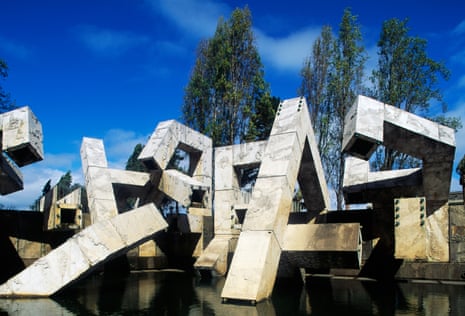
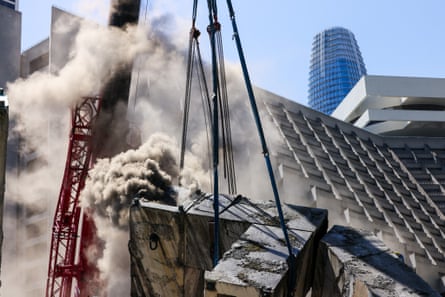
It was a surreal, fitting end for one of San Francisco’s most divisive public artworks: the Vaillancourt fountain, an enormous concrete sculpture looming over Embarcadero Plaza since the 1970s, had burst into flames.
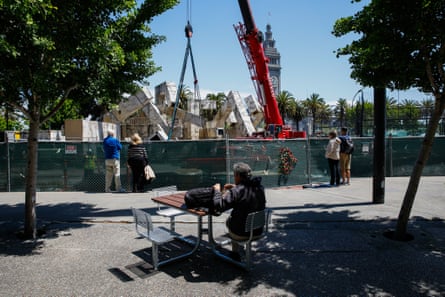
The hulking fountain’s angled arms were being dismantled in early May after the city voted to potentially replace it with an open, grassy park – a decision mourned by skateboarders like myself, who argued the city was losing an important piece of its skate culture and architectural heritage.
But as crews began to take it down, a spark from one of the torch-cutters likely ignited debris that had accumulated in one of the fountain’s tubes during the last year of its dormancy, sending flames and smoke shooting into the air over a structure that once pumped 30,000 gallons of water. It was a perfect last riposte of a fountain that was never not controversial.
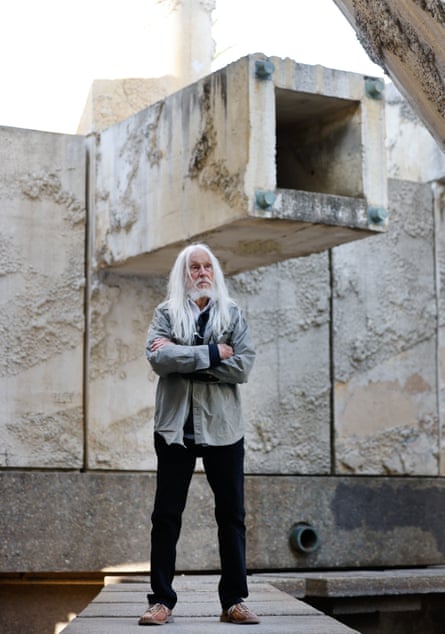
Built in 1971, the fountain designed by artist Armand Vaillancourt was the dynamic centerpiece to a red-brick plaza that became the epicenter of San Francisco’s skateboarding scene in the 1980s and 1990s. One of the most heavily photographed and filmed skate cities in the world, San Francisco’s unique, concrete-covered character is ideal for skateboarding, and though the fountain itself didn’t offer much for skateboarders save for the daring few who have attempted to roll down its chutes, its proximity to EMB (the acronym that stood for both the crew of skaters there, “Embarco’s Most Blunted”, and the Embarcadero location of the plaza) exalted the fountain from backdrop to landmark. Along with the Ferry Building across the street, Vaillancourt’s fountain was the beacon that drew you to the plaza, the one-time center of skateboarding’s universe.
In recent years, the fountain became a touchstone for debates about the legacy of modernist spaces in the city. Adjacent property owners and San Francisco’s parks department ran a campaign to condemn the fountain under an emergency injunction, claiming it was no longer functioning or safe. Others simply declared it an eyesore.
Activists, skateboarders and Vaillancourt himself, meanwhile, argued the city should maintain and preserve the work for its cultural significance. Skateboarders showed up to community input meetings, requested private chats with San Francisco’s parks department and generated online petitions to try to save the fountain and plaza. (Disclosure: I started a petition to acknowledge the skateboarding history at Embarcadero.)
After many debates over the aesthetic merits of the fountain, the San Francisco Arts Commission voted to decommission it. The fountain is currently being taken apart piece by piece to the tune of $4m for “storage and further assessment”.
Lawrence Halprin’s Embarcadero Plaza and Vaillancourt’s fountain were designed together as part of a dynamic vision of what San Francisco might be. Born of the era of freeways that drained many cities of their middle-class residents, the fountain, plaza and integrated subway system were all part of an attempt to sustain a spirit of vibrant urbanity in an era when most people shopped and socialized in suburbs.
The plaza and fountain boldly evoked medieval piazzas and baroque waterworks, encouraging immersive interaction – one could carefully traipse across the concrete lily pads behind its torrents of water – and get a sense of rambunctious nature within the density of the concrete jungle. Yes, it was originally next to a freeway, but it was also next to a four-block-long mall, sandwiched by parks, pedestrian boulevards and empty piers.
What made the fountain special, for me, was its immediate recognizability. Nothing else in the world looked like it. As someone who grew up worshiping at the radiant altar of street skateboarding in San Francisco, Vaillancourt’s fountain loomed large in my teenage fantasies. From the late 1980s onwards, every skateboarder recognized EMB long before it showed up in video games.
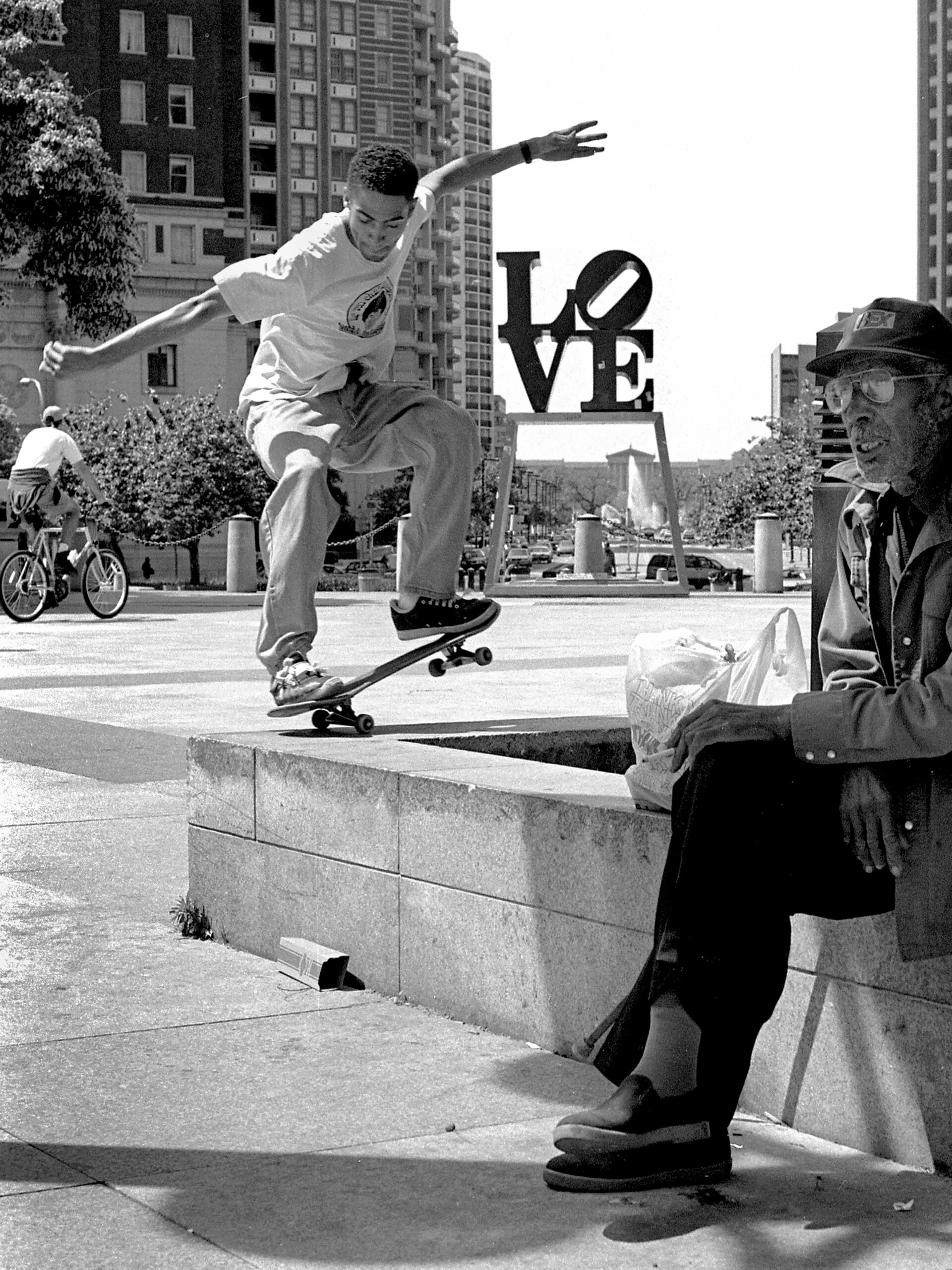
The best-known spots in skateboarding are often named after works of art nearby, from Love Park in Philadelphia (Robert Indiana’s sculpture at JFK Plaza), Pulaski Park in DC (Kazimierz Chodziński’s equestrian statue at Freedom Plaza) or, my personal favorite, “Tinker Toy”, the skater-generated nickname for Joan Miró’s monumental and multicolored avian form that stands sentinel over a once-skateable plaza in front of IM Pei’s Chase Tower in downtown Houston. Each plaza, all built from 1965 to 1980, offered smooth granite stone surfaces, steps and ledges, and all were anchored, like Embarcadero, by a dynamic work of modern art.
Each hours-long session spent skating around these modernist sculptures was, though we may not have known it then, closer to an immersive art experience. Spending time in or around these works of art, we generated new interpretations beyond the stated goals of these projects. The plazas, none of which was built for skateboarding, each produced new forms of public life, from the ground up, led by skateboarders.
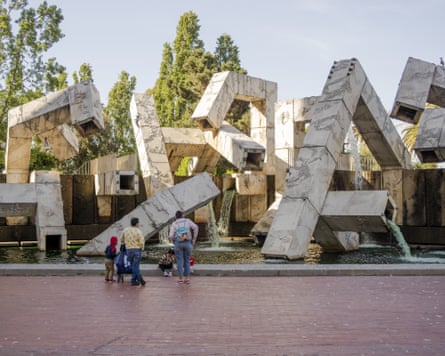
Halprin likely could not have imagined his red-brick plaza at the foot of Market Street would have become the epicenter of street skating some 20 years after its completion (and with important additions by William Turnbull Jr in 1982 of tiered steps, seating and a stage that became the most famous features of the skate spot), but the open-ended nature of the plaza, and plazas around the world from the same era, appealed specifically to skateboarders. We needed the open space, smooth surfaces and unexpected configurations of street architecture that Embarcadero offered. Vaillancourt’s fountain was a summation of the urge to skate street in the first place: it may be challenging, potentially painful, but if you commit, it’s worth it.
While eulogizing this fountain, I should clarify another thing: it was never brutalist, as many critics have described it. The fountain was indeed rough concrete, its scale massive, but most brutalist structures are raw, their serrated edges forged by the process of their creation. Instead, giant sculpted vermiculated patterns on the piers in the back of Vaillancourt’s fountain and oversized, sediment-like protuberances encrusting the square tubes in front evoked the striated patterns of travertine.
Riffing on the minuscule patterns of fountains like the Trevi in Rome, Vaillancourt also harmonized his sculpture with the late-modernist cityscape leading to it. To call this confrontational fountain “brutalist” is to flatten some of the most textured and participatory aspects of what made this plaza special.
Less special have been the spate of banal renderings of what the new Embarcadero Plaza might become, from an AI-generated mash-up of everything that’s bad about Manhattan’s High Line and Chicago’s Grant Park transposed to the foot of the Embarcadero Center, to the globular expansion of sure-to-be-soggy green lawns in the most current iteration of the plaza’s future landscape. While the original hardscape plaza was open-ended and designed for active play and passive leisure, each of the new renderings suggests specific, atomized activities.
The 6 May fire was quickly extinguished and Vaillancourt’s fountain will soon be gone. Many modernist projects for city centers have not aged well, but few sparked a paradigm shift in skateboarding like Embarcadero. The fire lit by that plaza, the urban skate scenes around the world directly inspired by Embarcadero’s incandescent example, still burns in our imagination, while these cherished skate spots have become landmark destinations in cities other than San Francisco.
Ted Barrow PhD is an art historian, writer, curator and lifelong skateboarder who lives in San Francisco. He hosts the YouTube series This Old Ledge for Thrasher magazine


Activists, skateboarders and Vaillancourt himself, meanwhile, argued the city should maintain and preserve the work for its cultural significance. Meanwhile after many debates over the aesthetic merits of the fountain, the San Francisco Arts Commission voted to decommission it.
Reading that after many debates over the aesthetic merits of the fountain, the San Francisco Arts Commission voted to decommission it — hard to argue with the logic there.
Considering activists, skateboarders and Vaillancourt himself, meanwhile, argued the city should maintain and preserve the work for its cultural significance, it raises some real questions about what happens next.
If activists, skateboarders and Vaillancourt himself, meanwhile, argued the city should maintain and preserve the work for its cultural significance, then the bigger picture starts to look very different.
What made the fountain special, for me, was its immediate recognizability. Meanwhile in recent years, the fountain became a touchstone for debates about the legacy of modernist spaces in the city.
When you look at what made the fountain special, for me, was its immediate recognizability, the implications are hard to ignore.
San Francisco has been vocal about this, good to see them staying on it.
Think about it: what made the fountain special, for me, was its immediate recognizability. That speaks volumes.
If what made the fountain special, for me, was its immediate recognizability, then the bigger picture starts to look very different.
20 years. The real figures are likely much higher.
The fact that lawrence Halprin’s Embarcadero Plaza and Vaillancourt’s fountain were designed together as part of a dynamic vision of what San Francisco might be really puts things into perspective.
The fact that activists, skateboarders and Vaillancourt himself, meanwhile, argued the city should maintain and preserve the work for its cultural significance really puts things into perspective.
Basically in recent years, the fountain became a touchstone for debates about the legacy of modernist spaces in the city. What matters is whether anything changes because of it.
What stands out is after many debates over the aesthetic merits of the fountain, the San Francisco Arts Commission voted to decommission it. That is the part worth paying attention to.
On one hand after many debates over the aesthetic merits of the fountain, the San Francisco Arts Commission voted to decommission it. But at the same time lawrence Halprin’s Embarcadero Plaza and Vaillancourt’s fountain were designed together as part of a dynamic vision of what San Francisco might be.