

‘You can bet on it’: Utah lawmakers form united front in push to ban prediction markets
Utah’s heavily Mormon population is largely opposed to all gambling, even on financial exchange platforms
Utah is home to some of the strongest anti-gambling laws in the US, with vehement opposition dating back more than a century. But as prediction markets have surged – allowing users to bet on almost anything, from elections to sports to geopolitical events – the state has not escaped the nationwide boom.
Its Republican leaders are fighting back, setting up a battle between one of the country’s most conservative states and a rapidly growing industry that is embraced by a Republican administration in Washington – and members of the US president’s own family.
“It’s a unique issue,” Brady Brammer, a Republican state senator in Utah, said. “Because you have a lot of very conservative Republicans [in Utah] who are standing up to a conservative administration, essentially without dissent among them.”
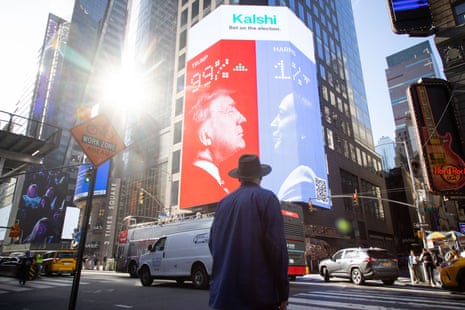
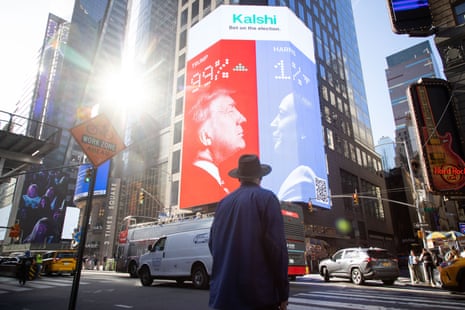
Prediction markets such as Kalshi – recently valued at $22bn – and Polymarket allow users to “trade” on events from Oscar picks to election outcomes, and have surged in popularity in recent years.
The platforms have long contended that they do not facilitate gambling – an argument they have used to bypass the conventional regulatory landscape for gambling firms – and they operate almost nationwide.
With the backing of federal regulators under Donald Trump, they classify their products as financial exchanges, governed by federal commodities law, rather than state gambling rules.
Unlike casinos or traditional sports books, which set the odds on customers’ bets, prediction market users “trade” against one another while the platforms collect transaction fees. A Kalshi spokesperson said the platform “operates like any other derivative market”.
But around the country, an increasing number of state officials are taking a different view. Prediction markets are simply gambling by another name, they argue, and an encroachment on state authority.
So far, roughly 20 federal lawsuits have been filed nationwide over the platforms, with early rulings seeing split results. Among the most outspoken opponents of these platforms are Republican lawmakers in Utah, a key battleground in this escalating engagement.
Spencer Cox, the Republican governor of Utah, has no time for the industry’s arguments. Prediction markets are “gambling – pure and simple”, he declared in February, and have “no place in Utah”.
Before Trump’s return to power in January 2025, the federal government appeared equally concerned about some of the platforms’ offerings.
Under then president Joe Biden, the Commodity Futures Trading Commission (CFTC), the government agency that regulates the US derivatives markets and oversees prediction markets, sought to impose restrictions on the platforms and ban certain event contracts tied to elections, politics and sports. The FBI raided the home of Polymarket’s founder in November 2024, as the site faced scrutiny.
Under Trump, however, the CFTC has reversed course, defended its jurisdiction over the sector and curtailed the Biden-era crackdown.
At the same time, the president’s eldest son, Donald Trump Jr, serves as an adviser to both Kalshi and Polymarket. The president’s own company the Trump Media and Technology Group, which operates his Truth Social platform, has also explored launching its own prediction market product.
“We have a president who operates casinos,” said Brammer, the state senator, referring to Trump’s past ownership of casinos. “He clearly has no problem with gambling, and so it’s not overly surprising that his agency heads, particularly in this space, are much more gamble-friendly than they previously have been, but Utah is not.”
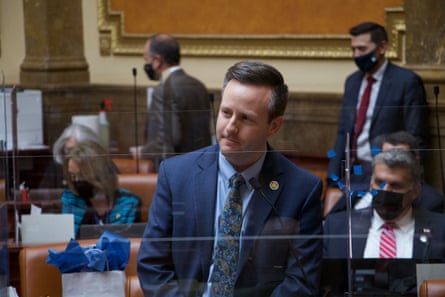
Brammer and his colleagues are prepared to push back. “It doesn’t matter whether it’s Trump, or Biden or whatever administration it is, we’re going to stand up for what we believe needs to happen in Utah,” he said.
After the CFTC said in February that it was filing a friend-of-the-court brief defending its “exclusive jurisdiction” over the platforms, Cox vowed that he would use “every resource within my disposal as governor” to challenge them in court.
Derek Brown, Utah’s attorney general, has taken a similar stance,arguing that placing a “trade” on these platforms is “simply a bet, dressed up in different clothing”. In an opinion piece for the Deseret News, Brown wrote: “Betting. Wagering. Trading on futures. A wolf in sheep’s clothing is still a wolf …
“I was recently asked whether I plan to do anything about the rapid rise of prediction market apps that are now operating in Utah,” he added. “My response? You can bet on it.”
The industry tried to get in first, taking the fight to court. In February, Kalshi sued Cox and Brown, alleging that Utah was preparing to block the company “from offering event contracts for trading on its federally regulated exchange”. The pair had “repeatedly represented that they believe Kalshi is operating unlawfully under Utah anti-gambling laws”, the company said.
Kalshi, which is seeking an injunction against any such ban, contends that any move by Utah to prohibit it from operating in the state would interfere with federal regulations – specifically those legislated by Congress to oversee financial derivatives and their exchanges. The litigation remains ongoing.
In a statement, a spokesperson for Kalshi said: “Whether a state has gambling operations or whether they ban it is irrelevant to federal law, which says you can have nationwide exchange for event contracts.”
“This is for the CFTC to decide, not the states,” it added. The CFTC and Polymarket did not respond to requests for comment from the Guardian.
Kalshi recently secured a victory in Arizona, where a federal judge blocked the state from pursuing criminal charges tied to alleged violations of state gambling laws. But the company has faced setbacks in Nevada and Tennessee.
“When we look around the country, they win some, they lose some,” John Holden, a business law professor at Indiana University who focuses on sports and gambling law, said of the prediction market platforms. “A lot of people would look at a state like Utah and basically say, well, they don’t have gambling, of course [Kalshi] is going to lose.
“But the reality is, when the federal judges are looking at these cases, they’re looking at, legally, is this something under the CFTC jurisdiction, in their view? And there’s clearly a lot of dispute here, because we’re getting these different court cases and decisions around the country.”
The complex patchwork of rulings raises a larger question, according to Holden: will the US supreme court take on this question?
With Utah’s legal battle ongoing, state lawmakers have moved to reinforce their position by amending the state constitution.
In March, the GOP-controlled Utah state legislature expanded the state’s legal definition of gambling in its ban to include “proposition bets” – defined as “a gambling bet on an individual action, statistic, occurrence or non-occurrence” – in a bid to ensure prediction markets will be covered. Cox signed the measure later that month.
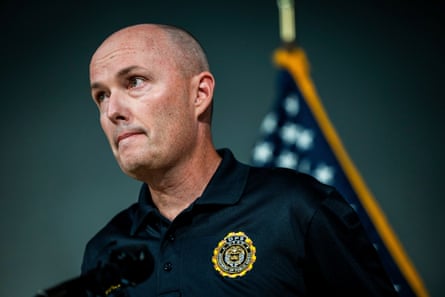
Prediction market platforms are “unacceptable” in Utah, and should not operate in the state, Brammer, the Republican state senator who sponsored the bill behind the constitutional amendment in the state senate, said.
They carry “every characteristic of gambling”, he argued – a view shared by a majority of Utahns. A recent poll found that 50% of adults in the state consider prediction markets to be gambling, while 30% do not.
Brammer believes that lawmakers in Utah will “fight to the bitter end, to the US supreme court, before we would acknowledge that it is appropriate to have prediction markets in Utah”, he said. The legislation passed unanimously in the state senate.
Democratic state senator Stephanie Pitcher, who also backed the measure, said she was concerned about the potential “of insider trading and a type of either market manipulation or certain outcomes that could come forward” on these platforms.
Even Trump, when asked last month about concerns that federal employees might be using insider information on the prediction markets, claimed he was “never much in favor” of the practice.
The companies say that they monitor for such risks. Earlier this year, Kalshi expanded its surveillance and enforcement efforts to detect and remove accounts engaging in insider trading and market manipulation.
Pitcher was not surprised Utah lawmakers have been so outspoken in their opposition. The state, along with Hawaii, remains one of the few without any form of legalized gambling, prohibiting everything from casinos to lotteries to sports betting.
Utah is heavily influenced by the teachings of the Church of Jesus Christ of Latter-day Saints, which counts more than 2 million members in the state – over half its population. And the church “really views gambling as a vice that leads to addiction, selfishness, destructive behaviors”, Pitcher said. “I think that is why you’re seeing Utah maybe a slightly different position than other red states.”
Patrick Mason, a professor of religious studies at Utah State University, added that Latter-day Saints are still “far the single biggest group in terms of powerbrokers in the state”, adding: “All of the Utah congressional delegation are Latter-day Saints – the governor, lieutenant governor, the senate and the house leadership are all Latter-day Saints.”
For the church, Mason explained, gambling is seen “as a moral issue” and “as a character issue” that can be tied to harmful social effects.“The church has also always had a very strong emphasis on a work ethic, on independence, on self-reliance. And they see gambling as trying to get something for nothing.”
Utah lawmakers are taking this fight to Washington, where the representative Blake Moore, a Republican from Utah, introduced the Event Contract Enforcement Act alongside representative Salud Carbajal, a Democrat from California, in March. The legislation, they said, would prohibit trading contracts tied to wars, illegal activity, elections and sports – and empower states to decide whether to allow the practice in their communities.
Moore has introduced 94 bills to the House floor in the five years since he was first elected, according to his congressional profile. “I’ve never had more interest in a single bill we just introduced,” he said. “So that’s a good sign.”
A Kalshi spokesperson said the company “already prohibit[s] markets directly tied to wars and illegal activity” and that “sports and elections markets are regulated by the CFTC”.
In the US Senate, another Utahn, Republican John Curtis, has introduced legislation alongside Adam Schiff, a Democrat from California, that would bar CFTC-registered entities from offering any contract that resembles a sports bet or casino-style game.
Curtis and Schiff, along with the Democratic senator Elissa Slotkin and the Republican senator Todd Young, have also introduced a bill that would ban federal officials and government employees from using insider information to trade on prediction contracts.
The Kalshi spokesperson said the firm is “supportive of legislation that codifies into law what we already do – ban federal officials and government employees from using insider information to trade on prediction markets”.
But Utah Republicans are not prepared to stand down.
“Let’s call a spade a spade: sports prediction markets are gambling, and gambling is regulated by states, not the @CFTC,” Curtis, the US senator, wrote on X in February. “Some wagers just aren’t smart – and betting against Utah is one of them.”
About the Author



Reading that utah’s heavily Mormon population is largely opposed to all gambling, even on financial exchange — hard to argue with the logic there.
The bigger issue here is utah is home to some of the strongest anti-gambling laws in the US, with vehement opposition dating back more than a century. That changes the calculation.
The fact that utah’s heavily Mormon population is largely opposed to all gambling, even on financial exchange really puts things into perspective.
If “It’s a unique issue,” Brady Brammer, a Republican state senator in Utah, said, then the bigger picture starts to look very different.
Think about it: utah’s heavily Mormon population is largely opposed to all gambling, even on financial exchange. That speaks volumes.
Brady Brammer is in a tough spot here, curious how they navigate it.
Reading that with the backing of federal regulators under Donald Trump, they classify their products as financial exchanges, governed by federal commodities law, rather than state gambling rules — hard to argue with the logic there.
What stands out is with the backing of federal regulators under Donald Trump, they classify their products as financial exchanges, governed by federal commodities law, rather than state gambling rules. That is the part worth paying attention to.
In other words “It’s a unique issue,” Brady Brammer, a Republican state senator in Utah, said. Curious to see how this develops.
On one hand utah is home to some of the strongest anti-gambling laws in the US, with vehement opposition dating back more than a century. But at the same time “It’s a unique issue,” Brady Brammer, a Republican state senator in Utah, said.
Utah is home to some of the strongest anti-gambling laws in the US, with vehement opposition dating back more than a century. Meanwhile “It’s a unique issue,” Brady Brammer, a Republican state senator in Utah, said.
Brady Brammer has been vocal about this, good to see them staying on it.
On one hand with the backing of federal regulators under Donald Trump, they classify their products as financial exchanges, governed by federal commodities law, rather than state gambling rules. But at the same time unlike casinos or traditional sports books, which set the odds on customers’ bets, prediction market users “trade” against one another while the platforms collect transaction fees.
Think about it: with the backing of federal regulators under Donald Trump, they classify their products as financial exchanges, governed by federal commodities law, rather than state gambling rules. That speaks volumes.
Its Republican is in a tough spot here, curious how they navigate it.