


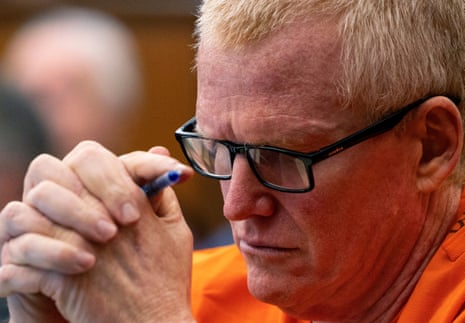
Alex Murdaugh retrial ruling offers twist in tangled tale of murder in US south
Can a new trial bring justice in the case of the disgraced South Carolina lawyer whose conviction for killing his wife and son has been vacated after court clerk’s misconduct?
Alex Murdaugh was not in court last Wednesday when a South Carolina appeals court vacated his 2023 double-murder conviction in the latest stunning twist in a legal saga that has captivated America and the world with its southern gothic tale of murder, betrayal and financial skullduggery.
Prison regulations had prevented the disgraced lawyer from watching a live stream at the high-security McCormick correctional institution. Nor were any of his relatives present, including son Buster, the only surviving member of his immediate family.
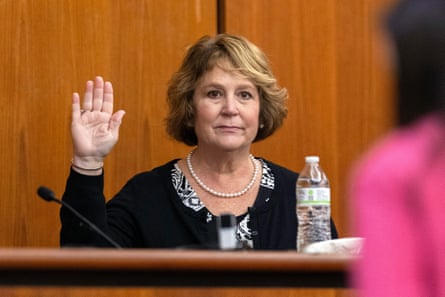
But Murdaugh, 57, will be heading back to court at some point, although not necessarily to Colleton county, where the court clerk, Becky Hill, was found to have improperly influenced the jury, including telling them to “watch his body language” and not be “fooled by evidence”, causing Murdaugh’s double-murder conviction to be thrown out.
The five justices of the South Carolina supreme court unanimously ruled that Hill “placed her fingers on the scales of justice, thereby denying Murdaugh his right to a fair trial by an impartial jury”.
The mistrial ruling sets the stage for another courtroom chapter in a case that has generated intense media interest, endless headlines and multiple TV documentaries. But can a second murder trial for the killings of Murdaugh’s wife and son elicit the same interest?
After the appeals court ruling came down, South Carolina attorney general Alan Wilson indicated he may raise the stakes, telling NBC News he may seek the death penalty at a second Murdaugh trial.
“In light of the supreme court’s decision, we’re back to square one on this case, and that means all our legal options are on the table, including the death penalty,” Wilson said.
Even if Murdaugh is found not guilty in a retrial, he won’t be freed – he is already serving a 40-year sentence for financial crimes including wire fraud, bank fraud, money laundering, forgery and embezzlement, including $3.4m from the family of his former housekeeper Gloria Satterfield, who died after falling down stairs at the Murdaugh home.
Still, the vacation of Murdaugh’s conviction is a striking twist in the tale.
Questions about juror tampering arose almost immediately after they deliberated for just two hours following a six-week trial during which the prosecution relied on circumstantial evidence, suggesting that jurors had made up their minds before deliberations, or potentially something else.
The gun or guns used to kill had never been recovered, nor had physical evidence ever placed Murdaugh at the kennels on the family property at the time his wife, Margaret, “Maggie” Murdaugh, 52, and his younger son Paul Murdaugh, 22, were shot dead in June 2021.
Prosecutors also hinted that Murdaugh’s financial problems were his motive in the killings, but that won’t be permitted in a new trial after the appeals court ruled it had created unfair prejudice.
“We were very gratified,” Murdaugh’s lawyer Dick Harpootlian said after his client’s conviction was vacated. “One thing this decision says is that the rule of law is alive and well in South Carolina, even if it’s on life support elsewhere.”
But can a court seat a jury panel in the lowlands of South Carolina that is not already immersed in the case? South Carolina’s attorney general, Alan Wilson, wants to retry Murdaugh before the year is out. The defendant’s lawyers says that’s not possible.
“No way this gets to trial this year,” Harpootlian told the State. “We have no judge assigned yet, the venue issue still needs to be worked out. We’re basically halfway through the year.”
Sam Bassett, a Texas criminal defense attorney, argues that Murdaugh deserves a new trial not because the verdict was necessarily wrong but because the trial process was jeopardized when jurors were invited by Hill to consider evidence outside the courtroom.
“It’s an interesting and unfortunate situation,” he says. Selecting a jury for a new trial, he says, “is going to be a challenge. It’s going to be worse than before because of the amount of media. A change of venue is one option a trial judge could grant, but given the level of publicity that may or may not solve the issue.”
But the question for future jurors may not be whether they have been exposed to publicity around the case, but whether that exposure predisposes them to a decision. More broadly, the prosecution in a retrial has an advantage because they are aware of the Murdaugh defense team’s prior strategies.
“In this case, they have the defendant’s prior sworn testimony. So that’s a real disadvantage, generally speaking. As a defense attorney, you need to reevaluate everything you did in the first trial and likely try to do something different.”
But Murdaugh’s co-counsel Jim Griffin told the State that a retrial gives the defense advantages. “You’ll have witnesses from the first trial and a transcript of what they said. So if they shade their testimony at all and try to be consistent, you can use that to cross-examine them.”
Griffin said a new trial would allow more things “to come to light, which we’re not ready to share”, but he would not be drawn on whether Murdaugh would again take the stand. That, he said, would be a “game day decision”.
The unravelling of the trial verdict came after Harpootlian and Griffin spoke to a juror and learned what Hill had been saying during the trial.
In their appeal, Murdaugh’s lawyers submitted two affidavits alleging that Hill had told jurors not to trust the defendant when he testified, held one-on-one conversations with the jury foreperson in a bathroom, gave jurors reporters’ business cards, and put pressure on them to return a quick verdict by denying them smoking breaks or threatening them with sequestration.
Hill later pleaded guilty to showing graphic crime-scene photos sealed as court exhibits to a photographer, two counts of misconduct in office for taking bonuses and promoting her book through her public office.
Hill’s book, Behind the Doors of Justice: The Murdaugh Murders, had already stirred controversy when she was accused by co-author Neil Gordon of plagiarizing passages from a BBC article.
In a foreword, author Rona Rich described how Hill ran the Colleton county court “with an iron fist deceptively wrapped in the softest silk”. Others said the Lowcountry grandmother was dubbed “Command Central” of the trial. She was known to banish anyone she considered improperly dressed to sit in the public galleries from court.
At last week’s hearing, South Carolina’s chief justice, John Kittredge, called Hill a “rogue clerk of court”.
That Hill may have been caught up in the sensationalism of the Murdaugh case and sought in turn to profit from it may be an outlier but there are indicators that media and influencer attention, together with protesters and supporters, can have a warping effect on the process of justice.
Hill was also said to have hurried jurors to reach a verdict, in part because she was booked to appear on a morning TV broadcast in New York soon after.
“Perhaps the trial judge should get some advisories from other judges who handle these kinds of cases and what they do to limit extraneous influences without trampling on people’s rights,” says Bassett.
But there’s a rich irony to the trial of Alex Murdaugh, a descendant of a family that in various ways held a long and controversial sway over jurisprudence in South Carolina’s Lowcountry.
After the ruling came down, Griffin told the State that Murdaugh was “in disbelief, because every legal ruling has gone against him, in civil cases, in criminal cases”, and was “having a hard time believing it’s true. He’s very grateful to no longer be convicted of murdering his wife and son, which he did not do.”
About the Author






In other words the mistrial ruling sets the stage for another courtroom chapter in a case that has generated intense media interest, endless headlines and multiple TV documentaries. Curious to see how this develops.
On one hand after the appeals court ruling came down, South Carolina attorney general Alan Wilson indicated he may raise the stakes, telling NBC News he may seek the death penalty at a second Murdaugh trial. But at the same time “In light of the supreme court’s decision, we’re back to square one on this case, and that means all our legal options are on the table, including the death penalty,” Wilson said.
The bigger issue here is prison regulations had prevented the disgraced lawyer from watching a live stream at the high-security McCormick correctional institution. That changes the calculation.
Reading that “In light of the supreme court’s decision, we’re back to square one on this case, and that means all our legal options are on the table, including the death penalty,” Wilson said — hard to argue with the logic there.
Think about it: the mistrial ruling sets the stage for another courtroom chapter in a case that has generated intense media interest, endless headlines and multiple TV documentaries. That speaks volumes.
“In light of the supreme court’s decision, we’re back to square one on this case, and that means all our legal options are on the table, including the death penalty,” Wilson said. Meanwhile can a new trial bring justice in the case of the disgraced South Carolina lawyer whose conviction for killing his wife and son has been vacated after court clerk’s misconduct?
Still waiting to hear what South Carolina actually plans to do about it.
Think about it: can a new trial bring justice in the case of the disgraced South Carolina lawyer whose conviction for killing his wife and son has been vacated after court clerk’s misconduct?. That speaks volumes.
But Murdaugh has been vocal about this, good to see them staying on it.
The detail about after the appeals court ruling came down, South Carolina attorney general Alan Wilson indicated he may raise the stakes, telling NBC News he may seek the death penalty at a second Murdaugh trial is something people should sit with.
So the bottom line is the mistrial ruling sets the stage for another courtroom chapter in a case that has generated intense media interest, endless headlines and multiple TV documentaries. Wonder how this will land.
The bigger issue here is “In light of the supreme court’s decision, we’re back to square one on this case, and that means all our legal options are on the table, including the death penalty,” Wilson said. That changes the calculation.
Reading that the mistrial ruling sets the stage for another courtroom chapter in a case that has generated intense media interest, endless headlines and multiple TV documentaries — hard to argue with the logic there.
Alex Murdaugh has been pushing this agenda for a while now.
The detail about prison regulations had prevented the disgraced lawyer from watching a live stream at the high-security McCormick correctional institution is something people should sit with.