
Prediction market Kalshi to give $2m to problem gambling group as it fights ‘gambling’ label
Kalshi announces two-year investment to National Council on Problem Gambling ‘focused on trader health and safety’
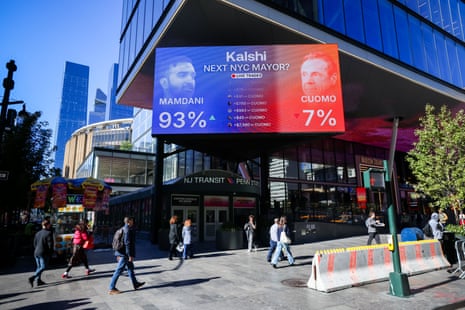
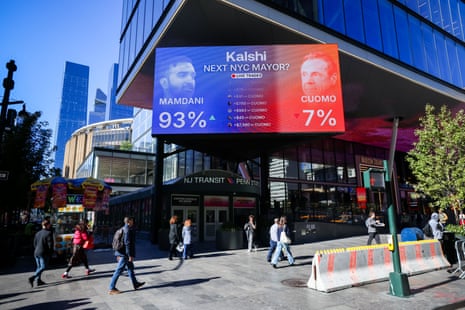
The prediction market Kalshi, which maintains it is not a gambling platform, has announced plans to give $2m to the National Council on Problem Gambling (NCPG) as it continues to ride a nationwide surge.
While prediction markets allow users to bet – or “trade” – on the outcome of almost anything, from elections to sports to geopolitical events, the industry has vehemently fought efforts by state officials to regulate its platforms like those of conventional gambling giants.
“Kalshi doesn’t work like casinos or sportsbooks,” the firm said in February, claiming that its platform “operates like any other derivatives market”.
The $2m two-year investment will support “a strategic initiative focused on trader health and safety”, the NCPG announced in a news release on Monday.
“NCPG’s role is not to determine whether a particular product or platform meets a legal definition of gambling,” Cole Wogoman, director of policy and partnerships at the NCPG, said. “Our responsibility is to understand where risky behaviors are emerging and ensure people have access to education, prevention resources, and support so we can help mitigate harm.”
As part of the partnership, the organization – which is largely funded by the gambling industry – has created a new membership subcategory for “Financial Services & Trading” firms.
Kalshi will join as a “Platinum-level member”, and will become the first company in the subcategory, which the non-profit described as “a defining commitment to long-term customer safety from the financial sector”.
Other “Platinum members” of the NCPG include casino operators like MGM Resorts International, betting companies such as DraftKings and FanDuel, and sports leagues including the NBA, MLB and NFL.
The surge of prediction markets, alongside a years-long betting boom sparked by the widespread legalization of sports betting across the US since 2018, has fuelled concerns around societal impacts, including addiction.
Prediction markets allow users to “trade” on the outcomes of events, from elections to award shows. The platforms operate widely across the US, including in states where conventional forms of gambling have long been banned.
Operators of prediction markets, like Kalshi and Polymarket, contend that they are financial exchanges, not gambling operators, and are thus governed by federal commodities law, rather than state gambling rules.
That distinction has become the subject of mounting legal and political battles, with an increasing number of state officials across the country arguing that prediction markets are simply gambling by another name, and an encroachment on state authority.
In the meantime, the industry has expanded rapidly and surged in popularity in recent years.More than $1bn was traded on Kalshi during this year’s Super Bowl Sunday.
In its announcement on Monday, the NCPG said that its new “Financial Trader Health and Safety Initiative” will “expand education and awareness of responsible trading” across financial markets, “through the development of practical, evidence-informed, and data-driven resources designed to keep pace with rapidly evolving platforms”.
The organization said that the effort comes amid broad public discussion around the intersection of “emerging platforms and consumer protection, behavioral health, and financial wellbeing” and said that the NCPG believes “cross-sector collaboration will be increasingly important as markets continue to evolve”.
“As financial trading platforms, prediction markets, and other retail participation products continue to evolve, we believe it is important to engage across sectors to promote informed participation and consumer awareness,” said Wogoman. “That engagement does not represent an endorsement of any particular platform or legal framework.”
Tarek Mansour, Kalshi’s co-founder and CEO, said on Monday that the company recognizes that prediction markets “like any financial trading products, come with risks”.
“As prediction markets continue to evolve, we are deeply committed to setting a new standard for responsible trading by investing in the tools, education, and protections needed to promote healthy participation and customer safety and hope that over time all trading platforms with significant retail participation follow suit,” he added.
In a social media post on Monday, Kalshi added that “while financial markets are fundamentally different from casinos and sportsbooks, there is still risk”. “No financial market with large retail participation is immune to risk.”
Considering “Kalshi doesn’t work like casinos or sportsbooks,” the firm said in February, claiming that its platform “operates like any other derivatives market”, it raises some real questions about what happens next.
When you look at “NCPG’s role is not to determine whether a particular product or platform meets a legal definition of gambling,” Cole Wogoman, director of policy and partnerships at the NCPG, said, the implications are hard to ignore.
The bigger issue here is as part of the partnership, the organization – which is largely funded by the gambling industry – has created a new membership subcategory for “Financial Services & Trading” firms. That changes the calculation.
Still waiting to hear what Financial Services actually plans to do about it.
Problem Gambling has been pushing this agenda for a while now.
On one hand the $2m two-year investment will support “a strategic initiative focused on trader health and safety”, the NCPG announced in a news release on Monday. But at the same time “NCPG’s role is not to determine whether a particular product or platform meets a legal definition of gambling,” Cole Wogoman, director of policy and partnerships at the NCPG, said.
On one hand other “Platinum members” of the NCPG include casino operators like MGM Resorts International, betting companies such as DraftKings and FanDuel, and sports leagues including the NBA, MLB and NFL. But at the same time “Kalshi doesn’t work like casinos or sportsbooks,” the firm said in February, claiming that its platform “operates like any other derivatives market”.
Considering the $2m two-year investment will support “a strategic initiative focused on trader health and safety”, the NCPG announced in a news release on Monday, it raises some real questions about what happens next.
The detail about other “Platinum members” of the NCPG include casino operators like MGM Resorts International, betting companies such as DraftKings and FanDuel, and sports leagues including the NBA, MLB and NFL is something people should sit with.
Basically as part of the partnership, the organization – which is largely funded by the gambling industry – has created a new membership subcategory for “Financial Services & Trading” firms. What matters is whether anything changes because of it.
“NCPG’s role is not to determine whether a particular product or platform meets a legal definition of gambling,” Cole Wogoman, director of policy and partnerships at the NCPG, said. Meanwhile as part of the partnership, the organization – which is largely funded by the gambling industry – has created a new membership subcategory for “Financial Services & Trading” firms.
Basically “Kalshi doesn’t work like casinos or sportsbooks,” the firm said in February, claiming that its platform “operates like any other derivatives market”. What matters is whether anything changes because of it.
On one hand as part of the partnership, the organization – which is largely funded by the gambling industry – has created a new membership subcategory for “Financial Services & Trading” firms. But at the same time other “Platinum members” of the NCPG include casino operators like MGM Resorts International, betting companies such as DraftKings and FanDuel, and sports leagues including the NBA, MLB and NFL.
On one hand “Kalshi doesn’t work like casinos or sportsbooks,” the firm said in February, claiming that its platform “operates like any other derivatives market”. But at the same time the $2m two-year investment will support “a strategic initiative focused on trader health and safety”, the NCPG announced in a news release on Monday.
The fact that other “Platinum members” of the NCPG include casino operators like MGM Resorts International, betting companies such as DraftKings and FanDuel, and sports leagues including the NBA, MLB and NFL really puts things into perspective.