

Mind-bending photos by anonymous cousins show the pain and dreams of Afghan women

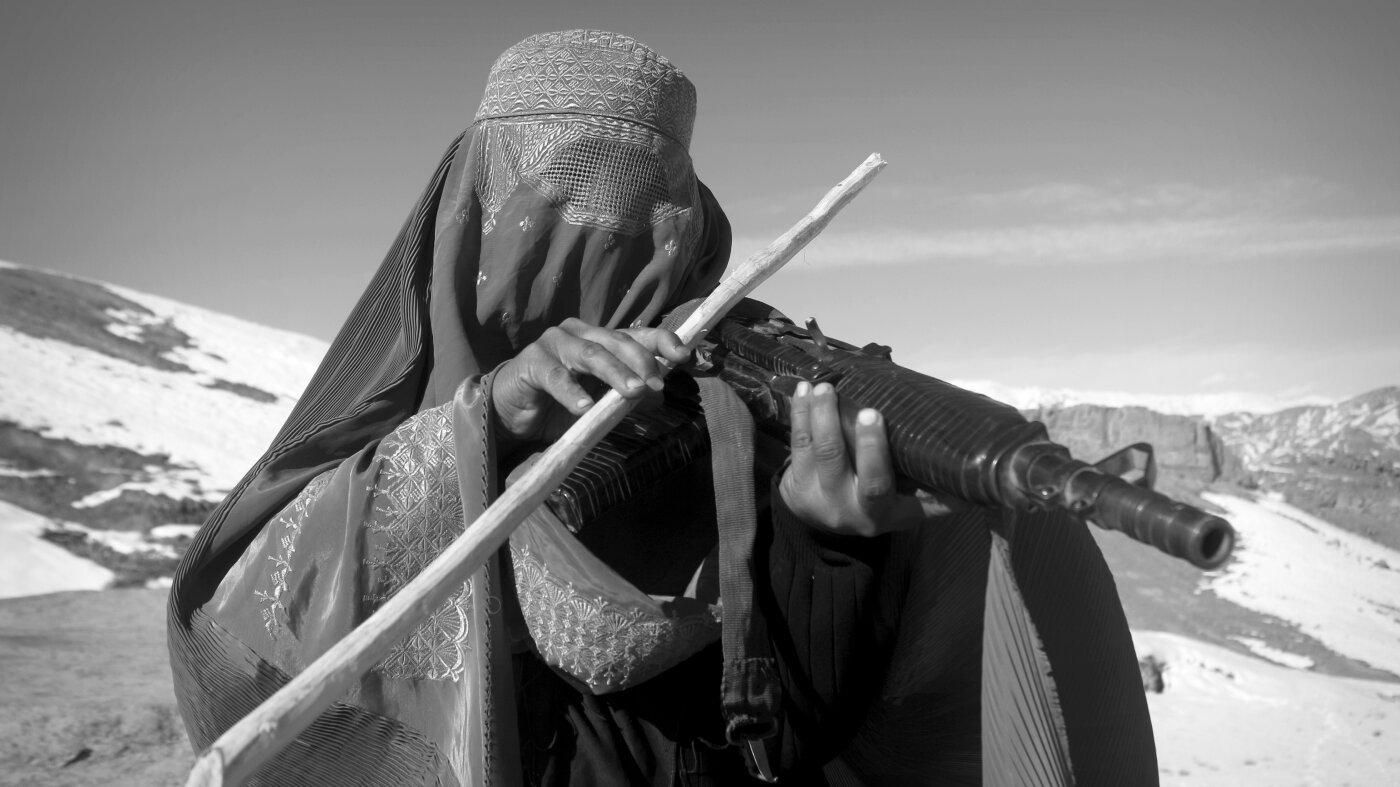
This photo, from a series of pictures by two anonymous cousins, is entitled “The Music of Poverty and Violence.” The subject is playing an automatic weapon as if it were a string instrument.
Mahnaz Ebrahimi|January 2026
hide caption
toggle caption
Mahnaz Ebrahimi|January 2026
Do these photos depict fiction or reality … or both?
A bicyclist whose dark, flowing burka enfolds her body from head to ankles sits with hands perched on the handlebar, seemingly undaunted by the meshed veil that covers her eyes and restricts her sight. Her determination is suggested by the photo’s title, “It will not stand in my way.”

This photo of a woman wearing a burka while riding a bicycle is titled “It will not stand in my way.”
Somayeh Ebrahimi/February 2025
hide caption
toggle caption
Somayeh Ebrahimi/February 2025
A similarly clad figure swirls so swiftly that the billowing fabric appears to lift her into the air like a bird in flight; scribbled in Farsi across the brick wall in front of her is the phrase, “I dreamed that my homeland was prosperous.”

“Courage means being afraid and trembling in the face of adversity, but with the courage, dance!” says photographer Somayeh Ebrahimi.
Somayeh Ebrahimi | February 2025
hide caption
toggle caption
Somayeh Ebrahimi | February 2025
A third burka-draped figure places an automatic rifle on her shoulder as she would a violin, “bowing” it with a long wooden stick as if to make music. The photo’s title is “The Music of Poverty and Violence.”
Two Afghan cousins who created these starkly evocative black-and-white photographs. They do not want their real names revealed because they fear Taliban retribution for their work. So they use the pseudonyms Mahnaz Ebrahimi (born in 2000) and Somayeh Ebrahimi (born in 2001). They live in a remote Afghan mountain farming village. They and their families, all members of the Hazara ethnic group and Shia Muslims, had previously worked as carpet weavers in Kabul. When the Taliban regained power in 2021, they left, seeking refuge from the repression and persecution permitted under the laws of the country’s ultra-conservative Sunni rulers.
Neither cousin had any training in photography when they started taking photos on their cellphones in 2022 or so, says Madrid-based curator and gallery director Edith Arance. She came across their work on Instagram and was struck by the skillful melding of their bleak surroundings with messages ranging from the poetic to the political.
“I know a little Farsi [the Persian language] so I could approach them,” she says. The cousins and Arance worked together via Instagram. In November 2024, Arance presented their work in Madrid, at her Galería Sura, which specializes in emerging photographers from Southwest Asia and Africa.
The photos, which document the sparse reality of the cousins’ lives today and their hopes for a less gloomy future, are on display through May 30 at the Photoville Festival in Brooklyn, New York. Arance uses the literary term auto-fiction to describe their work because, as in that genre, these photos also combine autobiography and fiction. While the images are set against the autobiographical backdrop of where they live, the poses struck by those photographed and their interactions with their physical and natural surroundings suggest interior dreams and fantasies, played out before the camera.
For Arance, the use of light and shadow, and the use of trees, leaves, plants and butterflies as symbols, are also akin to the literary style known as magic realism. The captions and poems accompanying were written by the cousins and translated by Arance.
In “Life Is Today” a young girl dances on a barren ridge overlooking snow-capped mountains. Arance comments: “There’s a sense of play, which should not be unusual. But this is Afghanistan, and this girl is not wearing a veil or a burka, she is just being free. Her shadow looks like an airplane flying away.”

This photo is titled “Life is today.” The photographers say the image is a call to live in the present as the future is uncertain.
Somayeh Ebrahimi/March 2024
hide caption
toggle caption
Somayeh Ebrahimi/March 2024
Other photos similarly question the highly constricted lives of women under Taliban rule.
“Liberation”shows a woman, her back turned to the camera showing the decorations in her hair (which are prohibited by the Taliban), as she throws herburka up and away into the sky. In its accompanying poem, Mahnaz Ebrahimi writes, “In the name of being a woman,/today I will free myself from oppression/and darkness to the breeze/to the height of the sky.”
“Girl by the Door” emphasizes contrasts in light and shadow, as a girl holding a tattered schoolbook stands with half her face hidden by a pale wooden door with multiple chains, the other half dimly lit against the dark background behind her.
The commentary by Mahnaz reads: “The image here is imbued with symbolism. For a time, after learning about the new law [prohibiting education for females after sixth grade], girls risked their lives by going to school. Attacks followed, intended to discourage families from allowing their daughters to attend classes throughout 2022. Light, knowledge, life resides outside. Darkness is the interior of the domestic space to which girls and women are relegated.”
The dichotomy between constriction and freedom is dramatized in the photo of a young girl wearing sunglasses and laughing with uproarious delight titled, “When Will We Laugh From the Bottom of Our Hearts Again”? But there is still the possibility of youthful delight, as shown in “Autumn Games,” in which three young girls throw leaves up into the sky.
Their photos pose questions about other restrictions imposed on girls and women. “Vestiges of the Present” captures a female figure in colorful garb, shown only from the shoulders down, holding a boombox that her still stance tells us is silent; “music, dancing and singing are prohibited for women [in public] in Afghanistan,” the caption reminds us.

This photo addresses the Taliban prohibition forbidding women to make music in public.
hide caption
toggle caption
In an outdoor scene, a young girl cowers as an unseen gunman points a rifle at her, but she holds on to a school notebook with a message in Farsi that reads, “There is no justice,” referring to the limitson girls attending school.
Taken as a whole, Arance says, the photos declare that “The Taliban may say that this is the destiny of women in Afghanistan, but I’m saying this is not my destiny.” As for that hoped-for future, aspirational glints appear in photos such as “From the Depths of Darkness,” which shows, against a black backdrop, a woman holding in her hand a mound of dirt and twigs from which a butterfly is emerging.
Similarly, “And the Glory of Growing Happens Within Us” captures, in profile, a burka-covered woman cradling in her hands a growing, blossoming plant, and perhaps finding inspiration in the ongoing life of its sprouts and buds.
Diane Cole writes for many publications, including The Wall Street Journal and The Washington Post. She is the author of the memoir After Great Pain: A New Life Emerges. Her website is DianeJoyceCole.com


Think about it: this photo, from a series of pictures by two anonymous cousins, is entitled “The Music of Poverty and Violence.” The subject is playing an automatic weapon as if it were a string instrument. That speaks volumes.
Still waiting to hear what Two Afghan actually plans to do about it.
The bigger issue here is this photo, from a series of pictures by two anonymous cousins, is entitled “The Music of Poverty and Violence.” The subject is playing an automatic weapon as if it were a string instrument. That changes the calculation.
Somayeh Ebrahimi has been vocal about this, good to see them staying on it.
So the bottom line is this photo, from a series of pictures by two anonymous cousins, is entitled “The Music of Poverty and Violence.” The subject is playing an automatic weapon as if it were a string instrument. Wonder how this will land.
Reading that this photo of a woman wearing a burka while riding a bicycle is titled “It will not stand in my way.” Somayeh Ebrahimi/February 2025 hide — hard to argue with the logic there.
Somayeh Ebrahimi is in a tough spot here, curious how they navigate it.
Basically this photo of a woman wearing a burka while riding a bicycle is titled “It will not stand in my way.” Somayeh Ebrahimi/February 2025 hide. What matters is whether anything changes because of it.
Considering this photo of a woman wearing a burka while riding a bicycle is titled “It will not stand in my way.” Somayeh Ebrahimi/February 2025 hide, it raises some real questions about what happens next.
Still waiting to hear what Somayeh Ebrahimi actually plans to do about it.
If a similarly clad figure swirls so swiftly that the billowing fabric appears to lift her into the air like a bird in flight; scribbled in Farsi across, then the bigger picture starts to look very different.
Two Afghan is in a tough spot here, curious how they navigate it.
When you look at says photographer Somayeh Ebrahimi, the implications are hard to ignore.
The fact that this photo, from a series of pictures by two anonymous cousins, is entitled “The Music of Poverty and Violence.” The subject is playing an automatic weapon as if it were a string instrument really puts things into perspective.
Considering says photographer Somayeh Ebrahimi, it raises some real questions about what happens next.