

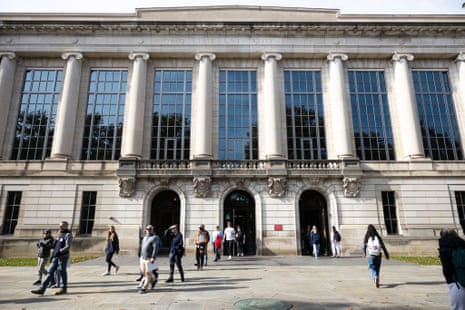

Ohio State reels from multiple scandals amid wider crisis in higher education
Ohio State is grappling with sexual abuse allegations and questions over donor influence as financial pressures mount across higher education
When Rocky Ratliff transferred to Ohio State University in Columbus to study political science and wrestle for the college in the mid-1990s, he soon found himself being sexually abused by a prominent member of the university athletic department’s medical staff.
At the time, Dr Richard Strauss, who is believed to have abused hundreds of student athletes over a period of decades at Ohio State, and who killed himself in 2005, would subject young men to intense abuse, including rape.
“I got inappropriate exams multiple times. With my high ankle sprain, I saw him almost every day for about a month,” recalls Ratliff, today a lawyer based in Marion, Ohio.
“He would start at your throat area then go to your chest and supposedly there are lymph nodes in your groin area. Ultimately, I’m there for a high ankle sprain and I’m going through the daily genital exams that seem to last a long amount of time.”
For 150 years, Ohio State University has been the biggest brand in the state and one of the biggest in American higher education. When thousands of manufacturing jobs were being eliminated during the late 20th century, the university’s football team, winning three national championships in the 1960s and 1970s, was a rare source of pride.
But today, one of the midwest’s most hallowed institutions is reeling from a series of scandals at a time when regional colleges are already facing major financial challenges.
On top of the sexual abuse scandal, in which the university has settled with hundreds of victims to the tune of $61m and counting, in March, Ohio State was thrown into deeper crisis when its president, Walter ‘Ted’ Carter Jr, resigned after it emerged he used public funds to help Krisanthe Vlachos, with whom he was having an inappropriate relationship, to build her podcasting business.
Among Carter’s transgressions was his facilitating of $60,000 worth of state funds for the podcaster, who also sought money from billionaire and Jeffrey Epstein associate, Les Wexner, according to the university’s own investigation. On at least one occasion, Carter allegedly fabricated to the university a business trip to Florida that was instead a trip he took with Vlachos.
The university is now on its fourth president in six years.
It was just the latest in a string of difficulties facing an institution that was once one of the most respected in the region.
In February, a professor of ethics assaulted a videographer who was attempting to ask a former university president questions about Wexner, an Ohio State University mega-donor and whose name adorns a host of campus buildings and facilities in Columbus.
Then on 7 May, 30 former Ohio State footballers represented by Ratliff were added to a federal lawsuit against the university for the Strauss sexual abuse scandal, which could cost it tens of millions of dollars more. A trial is expected to open later this year.
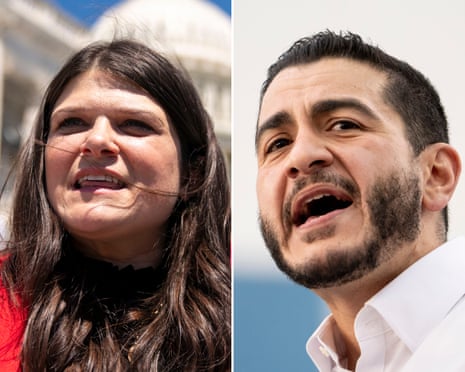
Prominent Ohio politicians have also been caught up in the strife.
A former Ohio State official this month stated under oath that he thought that the Republican congressman Jim Jordan, who was a coach on the aforementioned wrestling program during some of the years of abuse, was aware of it happening. Jordan has always strongly denied this and has gone on to have a successful career in politics as a Donald Trump acolyte.
A spokesperson for Jordan said: “As has been stated repeatedly, Chairman Jordan never saw or heard of any abuse, and if he had, he would have dealt with it.”
The sexual abuse at Ohio State was featured in a HBO documentary released in 2025.
Universities, the economic backbone in dozens of midsize cities across the country such as Columbus, are dealing with falling revenue due to fewer students coming through and the Trump administration’s clampdown on international students, who make up a considerable percentage of university income. Only four other states have experienced a steeper percentage decline in international student enrollments than Ohio.
It’s happening at a time when the falling national birthrate that began in 2007 is set to hit college enrollment numbers beginning this year. While many states have offset this either through immigration or attracting people from other states, in Ohio the issue is especially prominent, with the birthrate falling almost 16% since 2006.
According to the university, it contributes around $19bn to the state economy and supports 117,000 jobs.
“Time Magazine recently ranked Ohio State the fifth best public university in America, and the university’s research enterprise is now the 12th largest in the country – larger than Harvard and Yale,” says Ben Johnson, a university spokesperson.
“Ohio State is fortunate to have many committed donors, whose generosity supports students, research and life-saving clinical care. Les and Abigail Wexner have been great supporters of the university for many years,” says Johnson.
Yet the university has received hundreds of requests to have Wexner’s name removed from campus buildings and institutions. Wexner, who hired Epstein as his financier in the 1980s, has donated or pledged about $200m to the university over the course of several decades.
Last year, reports emerged that the Ohio legislature’s banning diversity, equity and inclusion measures at higher education institutions forced the university to eliminate eight programs and combine 20 others together. The university denied this, claiming the changes predated the law.
“It’s a very paradoxical moment for the university. On one hand, the university is thriving if you look at the amount of research money that’s been spent by the university, which passed $1bn per year a few years ago,” says Joel Wainwright, a professor at Ohio State’s department of geography who has been at the university for more than 20 years.
“On the other hand, there is no denying that the university is being throttled right now with multiple controversies and problems all coming together at the same time.”
Some, including Wainwright, are concerned that millions of taxpayers’ dollars are being pumped into the university to fund courses with a conservative bent and that an erosion of academic freedom is under way.
“From that position, I can attest that we are experiencing the most significant attack on academic freedom in the university in at least a century,” says Wainwright, who is also chair of the Committee on Academic Freedom & Responsibility at the university.
“It has had a very serious negative effect on the morale of the faculty.”

The bigger issue here is “He would start at your throat area then go to your chest and supposedly there are lymph nodes in your groin area. That changes the calculation.
The fact that for 150 years, Ohio State University has been the biggest brand in the state and one of the biggest in American higher education really puts things into perspective.
What stands out is for 150 years, Ohio State University has been the biggest brand in the state and one of the biggest in American higher education. That is the part worth paying attention to.
Hard to look at 150 years and not question the official narrative.
Considering but today, one of the midwest’s most hallowed institutions is reeling from a series of scandals at a time when regional colleges are already facing major financial challenges, it raises some real questions about what happens next.
On one hand “He would start at your throat area then go to your chest and supposedly there are lymph nodes in your groin area. But at the same time for 150 years, Ohio State University has been the biggest brand in the state and one of the biggest in American higher education.
The bigger issue here is “I got inappropriate exams multiple times. That changes the calculation.
Reading that but today, one of the midwest’s most hallowed institutions is reeling from a series of scandals at a time when regional colleges are already facing major financial challenges — hard to argue with the logic there.
On one hand for 150 years, Ohio State University has been the biggest brand in the state and one of the biggest in American higher education. But at the same time but today, one of the midwest’s most hallowed institutions is reeling from a series of scandals at a time when regional colleges are already facing major financial challenges.
So the bottom line is for 150 years, Ohio State University has been the biggest brand in the state and one of the biggest in American higher education. Wonder how this will land.
20 years — and that is probably just the official count.
So the bottom line is but today, one of the midwest’s most hallowed institutions is reeling from a series of scandals at a time when regional colleges are already facing major financial challenges. Wonder how this will land.
In other words for 150 years, Ohio State University has been the biggest brand in the state and one of the biggest in American higher education. Curious to see how this develops.
In other words “I got inappropriate exams multiple times. Curious to see how this develops.
What stands out is but today, one of the midwest’s most hallowed institutions is reeling from a series of scandals at a time when regional colleges are already facing major financial challenges. That is the part worth paying attention to.