



The Supreme Court avoids taking up a fight over Voting Rights Act enforcement for now

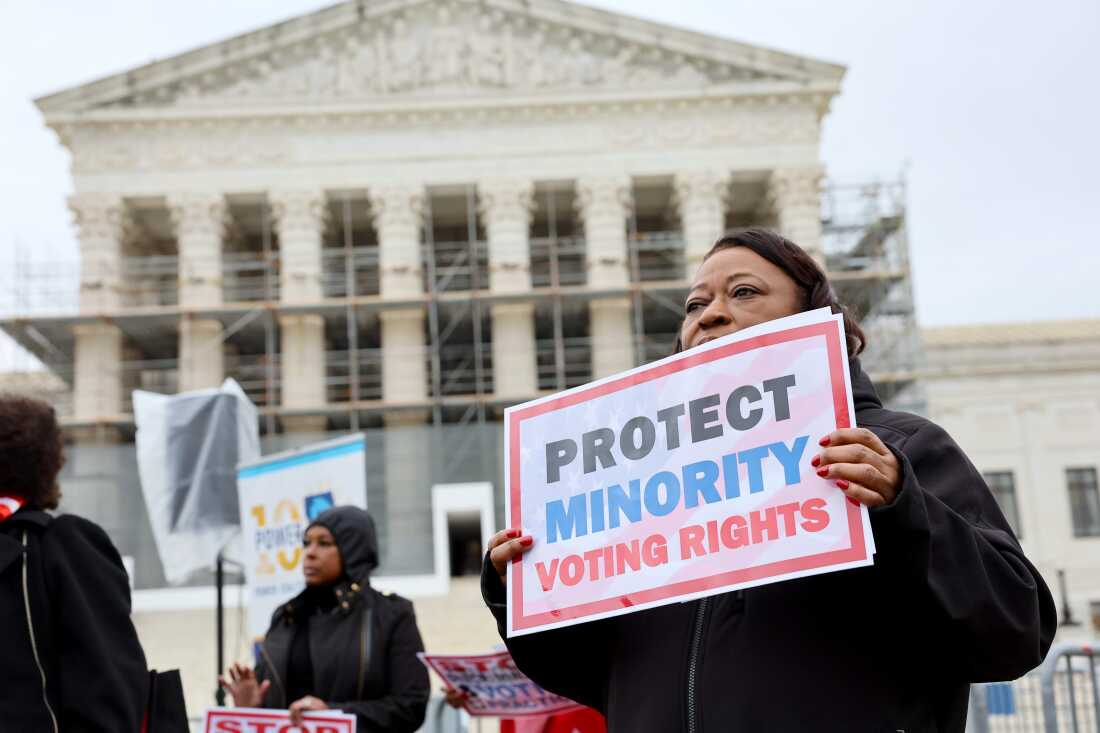
A demonstrator holds a sign saying “PROTECT MINORITY VOTING RIGHTS” at a March 2025 rally outside the U.S. Supreme Court in Washington, D.C.
Jemal Countess/Getty Images for Legal Defense Fund
hide caption
toggle caption
Jemal Countess/Getty Images for Legal Defense Fund
Weeks after further weakening the Voting Rights Act, the U.S. Supreme Court sidestepped weighing in on a legal question that could severely limit enforcement of the law’s remaining protections for minority voters.
In a brief, unsigned order on Monday, the high court announced it is sending cases about Mississippi and North Dakota state legislative maps back to lower courts to be reconsidered in light of its recent ruling in Louisiana v. Callais.

That landmark decision in April weakened the Voting Rights Act’s protections against racial discrimination in redistricting and as a result reignited the congressional gerrymandering battle sparked by President Trump ahead of the 2026 midterm election to help Republicans keep control of the House of Representatives.
Monday’s move by the court effectively allows the justices to take an off-ramp from hearing what could have been the next major Supreme Court fight over the landmark 1965 law.
What the court avoided in Monday’s order: a “private right of action”
What’s known as Section 2 of the Voting Rights Act has been mainly enforced as a result of lawsuits by voters and advocacy groups, who have brought hundreds of challenges to maps of voting districts and other election-related procedures.
But in the Mississippi and North Dakota redistricting cases, Republican officials have raised a novel argument — that private individuals and groups do not have a right to sue under Section 2, and only the U.S. attorney general does.
Such an interpretation would lead to far fewer Section 2 lawsuits, legal experts say.
The Supreme Court’s decision not to take up the question of what the legal world refers to as a “private right of action” under Section 2 drew pushback from liberal Justice Ketanji Brown Jackson.
In dissents from Monday’s order, Jackson pointed out the high court’s ruling in the Callais case did not address the legal question of Section 2’s enforceability by private individuals and groups.
“Thus I see no basis for vacating the lower court’s judgment,” Jackson said, criticizing the move to throw out earlier lower court rulings in both the Mississippi and North Dakota cases.
Enforcement of another Voting Rights Act section is also at risk
Still, while those cases now make their way back down the federal court system, the future enforcement of another section of the Voting Rights Act is also under question.

Section 208 generally allows voters who need help to vote because of a disability or inability to read or write to get assistance from a person of their choice. But in a case challenging an Arkansas law, a panel of the 8th U.S. Circuit Court of Appeals has found that private groups and individuals cannot sue to enforce Section 208.
That federal appeals court also ruled against a private right of action under Section 2 in the North Dakota legislative redistricting case.
In an opinion dissenting from the 8th Circuit’s decision not to review the panel’s decision in the Arkansas case, Chief Judge Steven Colloton, a nominee of former President George W. Bush, wrote the 8th Circuit continues on a “regrettable path of rendering unenforceable, in this circuit alone, the voting rights law that many have considered ‘the most successful civil rights statute in the history of the Nation.’ “
A Supreme Court brief on the Arkansas case is due Monday as the justices prepare to decide, at some point, whether to take it up.
Edited by Benjamin Swasey
About the Author




On one hand such an interpretation would lead to far fewer Section 2 lawsuits, legal experts say. But at the same time the Supreme Court’s decision not to take up the question of what the legal world refers to as a “private right of action” under Section 2 drew pushback from liberal Justice Ketanji Brown Jackson.
When you look at monday’s move by the court effectively allows the justices to take an off-ramp from hearing what could have been the next major Supreme Court fight over the landmark 1965 law, the implications are hard to ignore.
When you look at the Supreme Court’s decision not to take up the question of what the legal world refers to as a “private right of action” under Section 2 drew pushback from liberal Justice Ketanji Brown Jackson, the implications are hard to ignore.
So the bottom line is the Supreme Court’s decision not to take up the question of what the legal world refers to as a “private right of action” under Section 2 drew pushback from liberal Justice Ketanji Brown Jackson. Wonder how this will land.
North Dakota has been pushing this agenda for a while now.
Still waiting to hear what North Dakota actually plans to do about it.
The detail about such an interpretation would lead to far fewer Section 2 lawsuits, legal experts say is something people should sit with.
Think about it: a demonstrator holds a sign saying “PROTECT MINORITY VOTING RIGHTS” at a March 2025 rally outside the U.S. That speaks volumes.
Basically monday’s move by the court effectively allows the justices to take an off-ramp from hearing what could have been the next major Supreme Court fight over the landmark 1965 law. What matters is whether anything changes because of it.
The fact that a demonstrator holds a sign saying “PROTECT MINORITY VOTING RIGHTS” at a March 2025 rally outside the U.S really puts things into perspective.
In other words monday’s move by the court effectively allows the justices to take an off-ramp from hearing what could have been the next major Supreme Court fight over the landmark 1965 law. Curious to see how this develops.
The detail about a demonstrator holds a sign saying “PROTECT MINORITY VOTING RIGHTS” at a March 2025 rally outside the U.S is something people should sit with.
Considering a demonstrator holds a sign saying “PROTECT MINORITY VOTING RIGHTS” at a March 2025 rally outside the U.S, it raises some real questions about what happens next.
If monday’s move by the court effectively allows the justices to take an off-ramp from hearing what could have been the next major Supreme Court fight over the landmark 1965 law, then the bigger picture starts to look very different.
The detail about the Supreme Court’s decision not to take up the question of what the legal world refers to as a “private right of action” under Section 2 drew pushback from liberal Justice Ketanji Brown Jackson is something people should sit with.